The Motor Never Followed You Home
Why can a private person have better AI than an employee at one of the world’s largest consulting firms?
My son works at KPMG. I asked him what AI infrastructure he could use at work. His answer surprised me. In both access and sophistication, it was roughly an order of magnitude behind what I have built for myself as a private user.
One family conversation proves nothing about KPMG as a whole. It does expose an odd possibility: the most advanced tool in an office may be sitting outside the office.
Sam Altman has now admitted that he underestimated this gap. After GPT-4 arrived in 2023, he expected software businesses to become vulnerable much faster. Instead, he told David Senra, “the economy just has so much inertia.”
People keep buying from the same companies and using tools in familiar ways. Altman sees the delay as partly welcome because it may make the transition smoother.
My first answer was the standard historical one: this is electricity all over again.
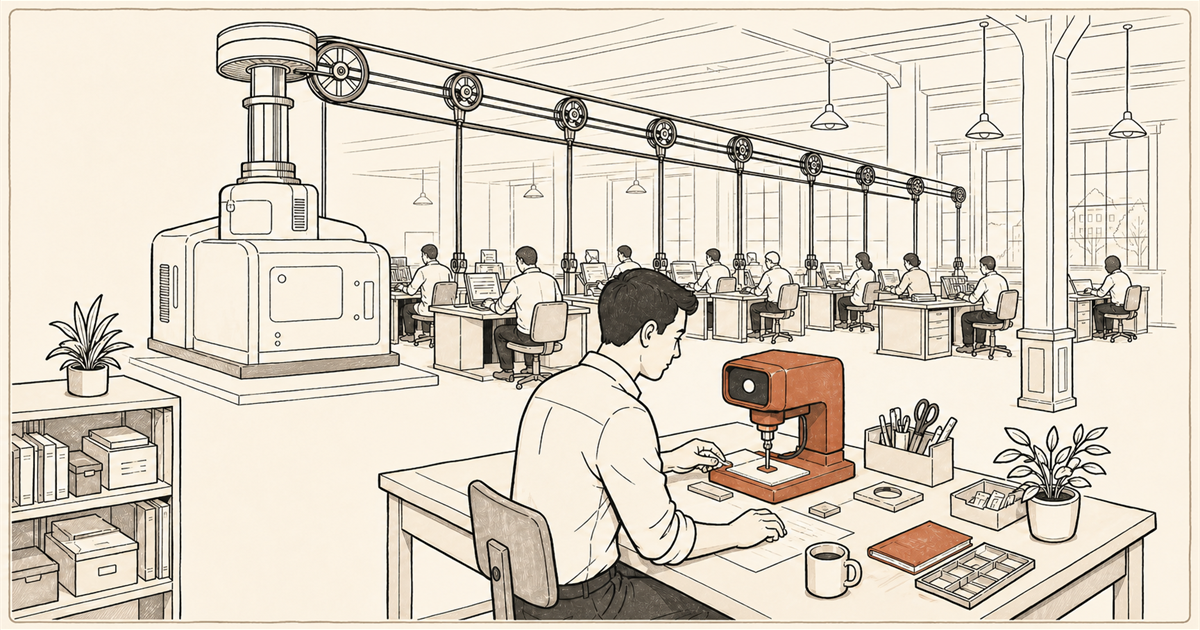
Edison’s Pearl Street station opened in 1882. Yet electric motors supplied less than 5 percent of the mechanical power in American manufacturing in 1899. Early factory owners often replaced a steam engine with one large electric motor. They left the shafts, belts, building, and workflow intact.
Economists later called this group drive. The power source changed. The factory did not.
The large gains came when factories moved to unit drive, with a small motor at each machine. Shafts disappeared. Buildings could spread across one floor. Machines could follow the order of production rather than their distance from the central engine. Manufacturing productivity grew at roughly 5.5 percent a year from 1919 to 1929, though electricity was only one of several causes.
The analogy earns its place. A chatbot attached to an old approval chain is group drive. So is an agent that can draft a report but cannot reach company data, use company software, or act without six people passing the output along.
The model may be new while the organization is still arranged around human information transfer.
But the analogy only gets us halfway.
Electricity had to reach each factory through generators, grids, wiring, motors, and new buildings. AI has physical limits too. Chips, data centers, and energy set a ceiling on how much capability can be supplied.
Yet those constraints do not explain the gap in my son’s office. A useful model already reaches a private user through a computer and an internet connection. The employee can meet the new technology before the institution has approved it.
That difference shows up in national data. In a 2026 survey, 18 percent of American firms reported using AI in a business function. Workers used it for job tasks in 23 percent of firms. Bottom-up use sometimes existed without formal company adoption. Even among users, most firms confined AI to three or fewer functions and three or fewer tasks.
This is not the old motor waiting for a cable. It is a capable tool pressing against a legal and organizational membrane.
What happens when the technology outside is better than the approved technology inside?
People do not become less aware of the gap. They route around it. They move a harmless task to a personal account, copy a fragment into an unapproved tool, or build a private workflow that the company cannot audit. The institution experiences this first as a security problem. The cause may be a productivity opportunity it has not learned to govern.
This is where I think technological viscosity pushes back on society. A company can slow formal adoption with procurement, compliance, old software, and sensible fear of mistakes. It cannot stop employees from seeing what is possible. Nor can it stop a new competitor from designing the company around the tool from day one.
Pressure builds at the boundary between what people can do and what the institution lets them do.
There are good reasons for that boundary. A consulting firm handles client secrets and legal exposure that I do not face at home. Reliable review, permissions, data controls, and accountability are not bureaucratic decorations.
The mistake is to use them to preserve the old workflow. They belong inside the new workflow that has not yet been built.
So does society dictate the speed of adaptation, as Altman says? In measured productivity and official deployment, yes. Technology cannot sign a liability policy, rewrite an org chart, or persuade a client to accept a new process.
But society does not set the pace alone. Once powerful tools become cheap and personally accessible, they create their own gradient. The larger the gap between private capability and institutional permission, the stronger the pressure to cross it.
Historical analogies are useful when they explain a mechanism. They become dangerous when they supply a timetable. Electricity tells us why organizations must rebuild the floor. It does not tell us how long AI will wait outside the gate.
The motor could not follow the worker home. This one already has.
