Why Very Smart People Get It Wrong
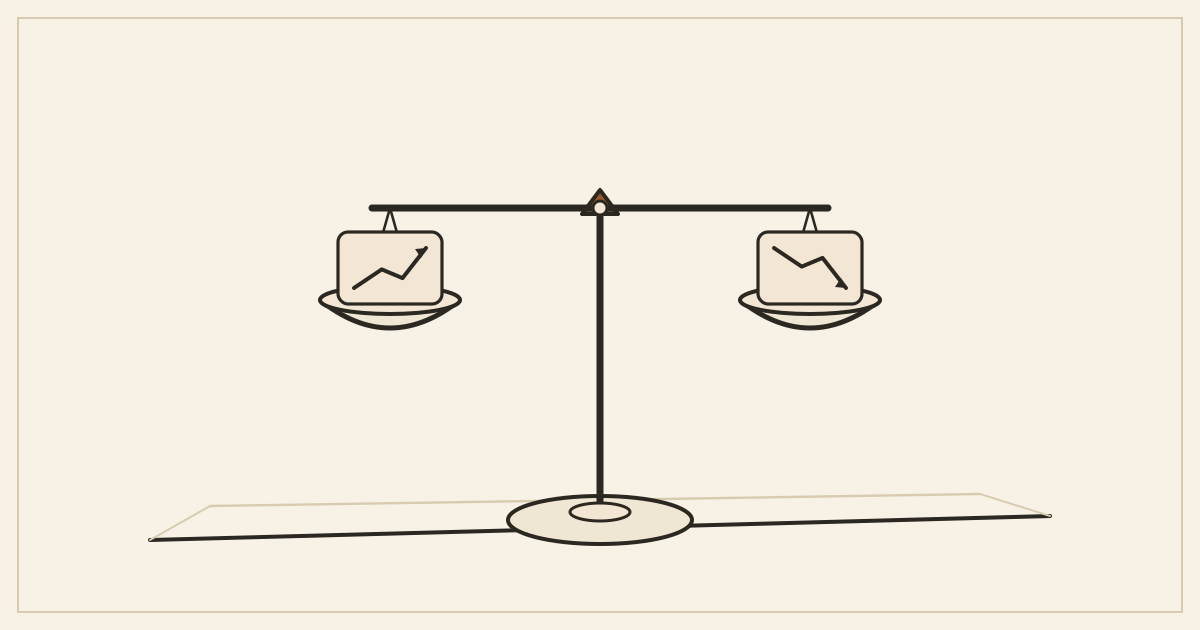
We have never been more sure of ourselves. Prediction markets are now a five-billion-dollar business; Polymarket and Kalshi post odds on elections, rate decisions, IPOs, wars, and the box office, and the number gets quoted back to us as if it were a fact of nature. Every question, live, to the decimal. A machine that tells you the future is on the price ticker.
So it’s worth rewinding ten years, to the last time a beautifully confident number fell on its face in front of the whole world.
The night before the 2016 US election, the New York Times had Hillary Clinton at better than an 80% chance of winning. Not a hunch — a model, fed by the best polling money could buy. Then the results started coming in.
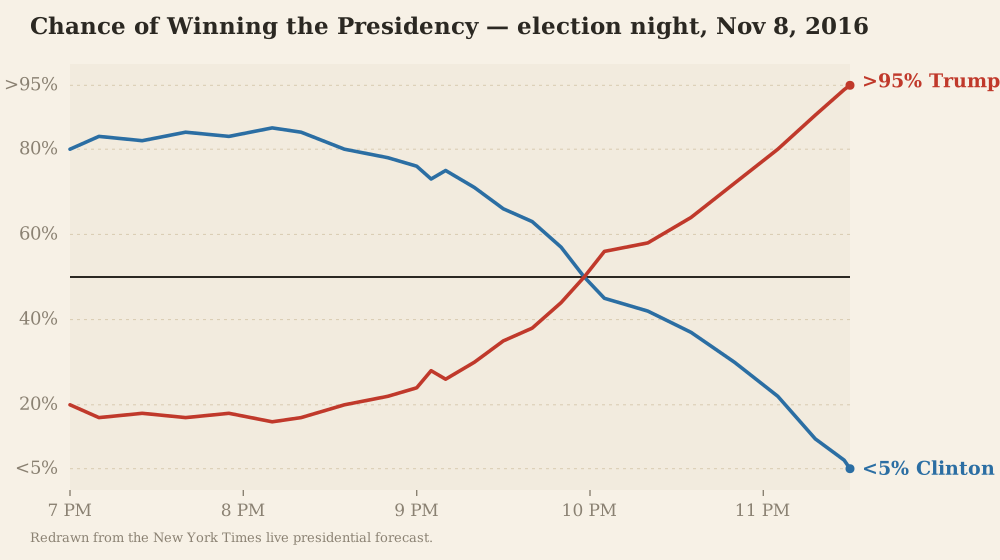
Nobody knows anything about the future. Write that on the inside of your skull.
The post-mortems started before the sun was up — how could the forecasts be this wrong? — even though we’d watched the exact same movie a few months earlier with Brexit. One of the sharper autopsies came from, of all people, Scott Adams, the cartoonist behind Dilbert, who’d been loudly calling a Trump win for a year while the professionals had Clinton cruising. He laid out the two frames each campaign was trying to trap the other inside: Trump as the unhinged racist monster, Clinton as the corrupt insider who belonged in prison. And out of those frames fell a quieter, more interesting effect. If you backed Clinton, your side owned the high ground — the smart, decent, forward-looking position — so you said so, loudly, at every dinner and every checkout line. If you backed Trump, you kept your head down. One camp was counted at full volume. The other was hiding.
Don’t file this under internet trolls. The same asymmetry ran straight through Wall Street. The analysts were near-unanimous: a Trump win meant a sell-off, somewhere in the 5-10% range. Bridgewater — the biggest hedge fund on earth, a firm I genuinely admire — put a number on it: a Trump victory would knock the Dow down 10.4%. Not “around ten.” Ten point four. You could laugh at the false precision, and you’d be right to, but they meant it.
And then, on the night, the futures did crash — the S&P dropped 5% in the dark, tripping the circuit breakers built for exactly that kind of panic. The consensus looked briefly like genius.
By the next afternoon the Dow was up 257 points, brushing an all-time high.
Gold, which everyone knew was the perfect Trump hedge, spiked overnight and then rolled into one of its ugliest weeks in years. More or less nothing the smart money said, in chorus, actually worked.
So — why do very smart people get it this wrong?
Honestly? It’s the least interesting question in the room. I only put it in the title so more of you would click. The question that actually matters is a different one, and its answer is the whole point: everybody is wrong, all the time. The very, very clever are wrong. And the truly frightening part — smart people are perfectly capable of being wrong in a crowd, in unison, with footnotes.
Which leaves the only question worth your time: what are you supposed to do with everyone else’s mistakes?
For that, we have to go back and sit by the stove a minute.
The first real shock waiting for anyone who wanders into markets is that you are not right very often. Always? You’ll be lucky to hit 50%. In the life you led before this, your ego — evolution’s kindest gift — carefully hid that fact from you. Think back over today. You made a hundred decisions; how many were right, how many wrong? You have no idea, because you never actually meet the consequences of most of them. So the ego does its job and whispers that today you were right 100% of the time. Yesterday too. It couldn’t work any other way — if you interrogated every trip to the shop, do I really need this, is it worth the money, what will my wife say, you’d lose your mind. So the default setting is: good call. Later, when a few bad decisions do come home, the ego helps again — you forget fast, you rationalize, you explain. A few duds fit fine in the deck. We’re people, not machines. Ninety-odd percent feels about right.
Markets take a wrecking ball to that picture. Step in and it turns out you’re nowhere near 90%, or even 50% — you’re below it. Mental panic sets in, and the number gets worse. Every bad decision is shoved in your face, on the screen, in money. Whether you like it or not, you’re forced to admit you make a lot of bad calls.
No matter — help is at hand. Lean on other people! And this is where it gets genuinely cunning.
How do we pick who to lean on? Read credible sources, obviously. Not some no-name blog with a ridiculous name — the serious papers, the big desks. Then you notice they say one thing on Monday and the opposite on Thursday, usually at the worst possible moment. Fine, move on: pick your oracle more carefully. That guy nailed the top last time, he’ll be right again. Soros is one of the greatest investors alive, surely he doesn’t miss. The people running the giant funds understand this game far, far better than you do.
And then, slowly, the floor gives way: nobody is exempt. However clever, however rich, however many voices are singing the same note — the chance of being wrong sits in the deck, every single time, permanently. Take 2016: if you’d bought the story that Trump meant a crash, you’d have dumped everything in the overnight panic just in time to watch the biggest one-day rally in ages without you. If you’d bought the gold story, you’d have sat through a brutal week. The smart people, as a group, were a reliable way to lose money.
And it usually goes like this in markets, right up until one of two things happens. Most people get so turned around that they start muttering about manipulation and conspiracies, and eventually walk away angry and poorer, cursing a rigged game. A rarer few notice something else: the chaos isn’t coming from them out there, it’s coming from you in here. You didn’t do your half of the work. You showed up expecting someone else to tell you what, where, and how, leaving you the easy part — read it, do it. That was never going to fly.
Your job, the one you can’t outsource, is to build a mental framework you can then fit other people’s opinions into. Properly weighted. Your own fallibility and theirs left switched on. And — this is the big one — with contradictory pieces of information kept alive inside the system at the same time. That last trick is one of the deepest secrets of the whole business. More than one study has found that the most successful people in markets are the ones who can hold mutually contradictory ideas in their heads without needing to resolve them. Most of us do the opposite: we settle on a view and then quietly ignore everything that argues against it. That’s the recipe for peace of mind in ordinary life. In markets it’s poison. The worst mistake you can make is not being wrong about something — it’s believing it with deep conviction. Dodging that is the job, and a decent framework is what lets you.
None of this has to be grand. You’re not training to be Soros. “I don’t read the financial press, I don’t try to figure out what’s happening, I just run a simple mechanical portfolio” is a perfectly excellent framework. But even then you have to take yourself seriously, because the thing that kills every simple plan is second-guessing. If you chose 60/40 because it’s simple, then don’t start timing it or nudging it on a whim. If you chose a dynamic system, don’t overrule it because right now it really looks like something.
And if you’re the type who enjoys understanding the world, by all means keep reading the news — the whole game there is whether you can handle other people’s errors, and your own. A few markers for the road:
- Trading is, mentally, a process of tearing your ego down. If that’s a problem — if being the smartest, sharpest person in the room is load-bearing for your sense of self — don’t even start.
- Respect facts to the point of obsession. They’re the firmest anchors you have. What you think of Trump, or any politician, matters far less than how the policies they actually push tend to move the economy and the market. Weight hard data heavily. There’s nothing to argue about in whether growth is rising or unemployment falling or a stock is up. Ask the empirical questions: how does the market usually behave around elections? How big can the surprises get?
- Everyone is wrong often, including the greats. Never hand anyone’s opinion more than a 60% probability.
- Consensus usually doesn’t work in markets. When a lot of people say the same thing — however logical, however credible — treat it with heavy suspicion. Naturally, now and then consensus will be dead right, just to keep you honest.
- Learn how the news actually works. Some of it lives on ads, sensation, and clicks — which means bad news; some of it is building someone’s ego. Supporting your trading is nobody’s first priority.
- If you can basically see your own mistakes but still feel stressed and prone to snatching at things, cut the risk. Smaller positions.
- If it’s mostly working — you’re clearing the hurdles — but a surprise crisis lands and you honestly can’t decide what to do, halve your risky positions. It takes the edge off the stress, lets you think with a cold head, and builds a small mental win-win: if you sold half and it rises, you’re glad you kept half; if it falls, you’re glad you sold half.
Ten years on, the tools have only gotten slicker. The number on the screen is faster, prettier, more liquid, more confident than the 2016 needle ever was. None of that changes the one line worth keeping: nobody knows anything about the future. It is far more useful to get ready for several futures and react to the one that shows up than to predict the one that can’t be predicted.
