The String Under the Table
Benjamin Franklin had a problem in the Pennsylvania Assembly: a new member disliked him and was gaining influence. Franklin did not flatter him. He asked to borrow a rare book.
The man sent it. Franklin returned it with a warm note. At their next meeting the rival spoke to him politely for the first time; they later became friends. Franklin told the story in his autobiography as proof of an old maxim: someone who has done you one kindness will be more ready to do another.
A neat trick.
It also shows the problem with almost everything sold as how to make people like you. Once liking becomes the goal, the other person can turn into a mechanism. Franklin wanted a political opponent moved. The friendship may have become real; the opening move was still planned.
So what does the science really say?
Start with reciprocity, but the right kind. This is not just the rule that a free mint makes you tip the waiter. In a 1986 experiment, Rebecca Curtis and Kim Miller made participants believe that a stranger either liked or disliked them. That belief changed how they acted toward the stranger, and their behavior helped make the original fiction true: people who thought they were liked became easier to like. This was not a compliment dropped into a social vending machine. It was a loop. Expect warmth, show more warmth, get more warmth.
That matters because the mechanism starts with a perception, not a fact.
Similarity has the same hidden door. The textbook answer is familiar: we prefer people who share our attitudes, values and tastes. In the lab, that effect is strong. But a large research synthesis gathered 385 effect sizes from 293 studies and found something less useful for a networking seminar. In field studies of real relationships, actual similarity had only a small to non-significant link with attraction; after correcting for publication bias, it was no longer significant. Perceived similarity, though, was often strongly tied to attraction.
Sit with that for a moment. We may care less about whether our maps truly match than whether I feel that you see the landscape as I do. Similarity can confirm my beliefs, lower uncertainty and make you easier to predict. It can also be faked. A salesman does not have to share your obscure hobby if he can make you think he does.
Now guess which version the self-help shelf teaches.
Mere exposure sounds even more like a machine. Robert Zajonc made the effect famous: repeated contact with a neutral stimulus can raise liking without a big argument or even much awareness. It works beyond rows of nonsense words in a lab. In a 1992 classroom experiment, confederates attended a large lecture zero, five, ten or fifteen times, without speaking to the students. More appearances produced more affinity. Familiarity was doing social work while everyone was meant to be studying something else.
But repetition is not hypnosis. A 1989 meta-analysis found that stimulus type, complexity, sequence, exposure time, recognition and number of presentations all changed the size of the effect. Familiarity can make something easier to process and less uncertain; it cannot turn any disliked person into a beloved one by forcing another twelve meetings in the lift. Anyone selling an exact exposure count is selling the lab coat with the advice.
Then we get warmth and competence, the two axes that explain more social judgment than most of us might enjoy knowing. Susan Fiske’s work describes warmth as the answer to what do you intend toward me? Competence answers can you do it? The order makes sense. Friend or foe comes before able or unable.
The combinations matter. People seen as warm and competent tend to draw admiration. Warm but incompetent tends toward pity; competent but cold toward envy; low on both toward contempt. The pattern appears across cultures, with differences around the edges, and similar dimensions shape impressions of individuals as well as groups. So being as nice as possible is not the formula. A friendly bungler may be liked but not trusted with anything important. A brilliant icebox may be respected and quietly left out of lunch. Full regard needs goodwill and the ability to make it count.
What if this whole effort to optimise ourselves starts with the wrong diagnosis?
In five studies published in 2018, people regularly underestimated how much new conversation partners liked them. Researchers found this liking gap after short, medium and long conversations, among strangers and workshop participants, and for months among new dorm mates. The signs of liking were often there. People were too busy with their own inner commentary — I talked too much; that joke died in the hallway — to see them.
So the most evidence-based “trick” may be to stop fixing a rejection that never happened.
None of this makes planned social skill dirty. Listening carefully is planned. Remembering a name is planned. Choosing not to dump your mood on a waiter is planned, and thank God for civilisation. Being authentic does not mean blurting out every impulse in the order it arrives. The boundary cannot be intention alone, because every invitation, joke and apology has an intention.
I would draw the line somewhere else. Rapport survives full light; manipulation needs something kept dark.
If the similarity is made up, the kindness is a deposit on a hidden demand, the repeated contact is hard to escape, or warmth is performed to switch off scrutiny, the other person is not just being influenced. Their choice is being written with missing information. Three questions uncover most of it. Is the cue true? Can the other person see what I want? Can they say no without paying a hidden price?
That is why the same cup of coffee can be hospitality, salesmanship or a trap. The psychology in the cup is unchanged. The information, the interests and the way out are different.
And the full-light test is painfully simple: if explaining the method would ruin the effect, what was really doing the work?
We will never stop shaping each other. A warm face changes a room; a cold one does too. The honest goal is not contact without influence, because that does not exist. It is contact where the other person stays a person instead of becoming a button.
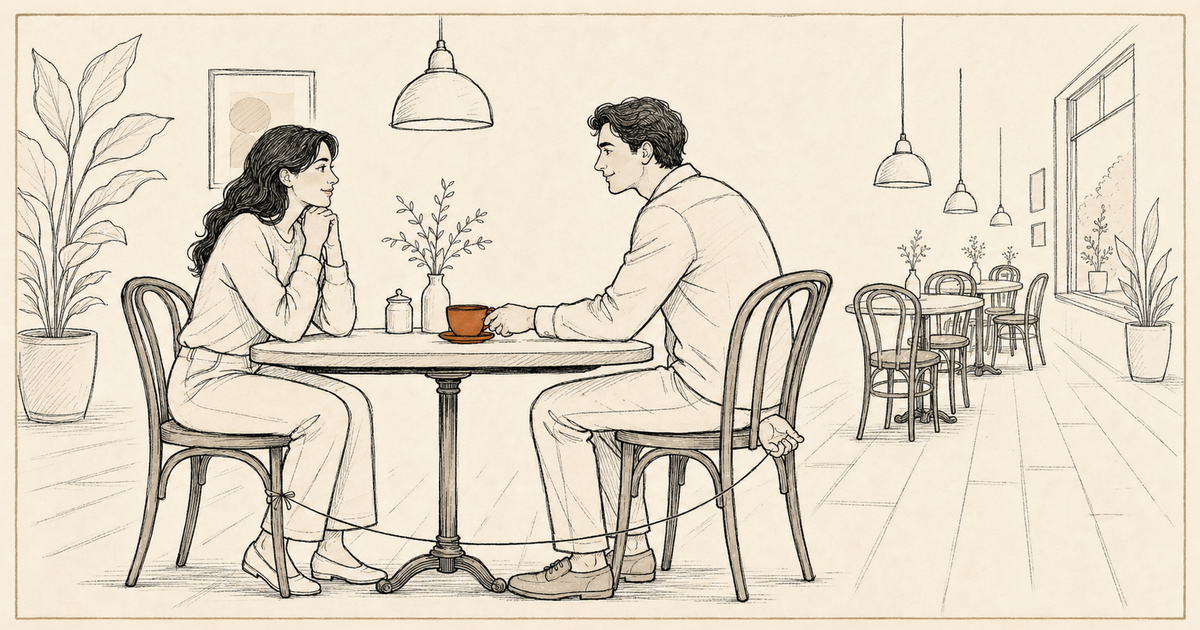
So look under the table. If they saw the string, would they still be free to stay?
