The Revolution Can Be a Bubble
On Tuesday, Apple briefly became a five-trillion-dollar company. The strange part was not the number. It was why the market liked it.
Apple had added roughly $600 billion in value since late June while investors fled the companies writing the largest cheques for artificial intelligence. Apple spends about 3% of revenue on capital equipment. Meta is heading towards 55%; Alphabet towards 40%. Apple can rent part of the AI stack instead of owning every data centre beneath it.
The company once mocked as an AI laggard had become the safe AI trade by declining to lead the charge.
This looks like a verdict on artificial intelligence. It is not. It is a verdict on who should pay to build it.
That distinction matters because we keep asking the wrong question. Is AI a revolution or a bubble? We talk as if one answer must kill the other. History’s most useful technology booms suggest the opposite. A technology can remake the economy, its infrastructure can be overbuilt, and its early shareholders can still lose a fortune. All three can be true at once.
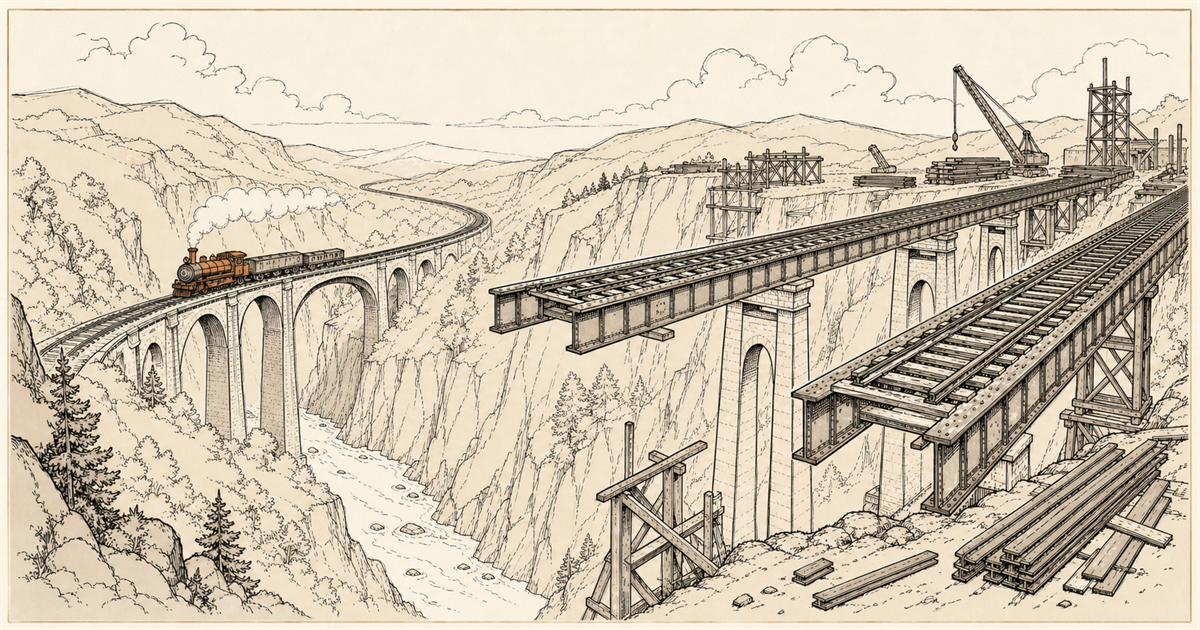
Britain learned this with railways. In the 1840s, promoters sold a future of faster travel, wider markets and cities pulled closer together. They were right. They also built roughly 20,000 miles of line where later estimates suggest 13,000 would have done the job. Routes were duplicated, capital was wasted and investors were ruined.
The railway did not fail. The railway shares did.
The same thing happened with fibre-optic cable in the late 1990s. Traffic was forecast to double every ninety days. It grew fast, but closer to once a year. Telecom revenue never delivered the promised surge. Firms collapsed under debt and miles of cable went dark.
Then the internet quietly consumed the excess. The infrastructure that had been ruinously expensive for its builders became cheap capacity for the companies that came later.
This is the point the usual bubble debate misses. It mixes three separate ledgers.
The first ledger asks whether the technology does useful work. AI has already cleared the trivial version of that test. It writes code, translates, searches large bodies of text, assists research and handles parts of customer service. None of this proves that it will transform the whole economy, but calling the technology empty now requires a determined refusal to look.
The second ledger asks which companies will turn that usefulness into durable profit. That is much harder. A valuable technology can produce brutal competition, falling prices and no moat. The customer may capture most of the gain. The supplier may build the market and still earn a poor return on the capital required to stay in it.
The third ledger asks what price an investor paid before any of this was known.
That one is merciless.
A company can dominate a real revolution and still be a terrible investment if the share price already assumes twenty years of victory. Another can arrive late, rent the infrastructure after prices fall and capture the best economics. The railway passenger did not care which original shareholder went bankrupt. The packets moving through cheap fibre did not mourn WorldCom.
Apple currently owns the most interesting option in this argument. It controls the customer relationship through billions of devices, can buy intelligence from competing suppliers and has not tied its balance sheet to winning the data-centre race. If models keep improving and their price keeps falling, patience may look brilliant.
It may also look foolish. If scarce computing capacity, proprietary models and the learning gained from operating them become lasting advantages, the companies spending now will own the toll roads and Apple will be renting someone else’s future. Nobody knows which way that goes. A five-trillion-dollar price tag does not improve our eyesight.
So can a mania be recognised from inside? Not with the clean confidence people want. You can spot the conditions: spending outruns the cash it produces; every competitor’s valuation assumes it will be one of the few winners; rising prices are treated as evidence that the story is true; and nobody can name the fact that would make them change their mind. Those are warnings, not clocks.
Calling the top is harder because the skeptics must survive being early. Julian Robertson rejected dot-com valuations and closed Tiger Management in March 2000 after clients pulled money. His broad objection was vindicated almost immediately. His business still did not live long enough to enjoy it.
Markets do not pay for being eventually right. They pay for being right while you can remain solvent.
That is why this distinction fails again and again. A real technical advance keeps producing genuine good news, which finances more capacity, which lowers costs, which creates more adoption, which justifies an even larger story. The feedback loop contains evidence and fantasy at the same time. From inside, cutting one away from the other is not analysis with a better spreadsheet. It is a bet on how much future demand has been pulled into today’s price.
Apple’s five-trillion-dollar moment does not tell us that the AI revolution is fake. It tells us the market has started to worry about the invoice.
The train can be real. The shares can still be a fantasy.
