All In, and Grinning
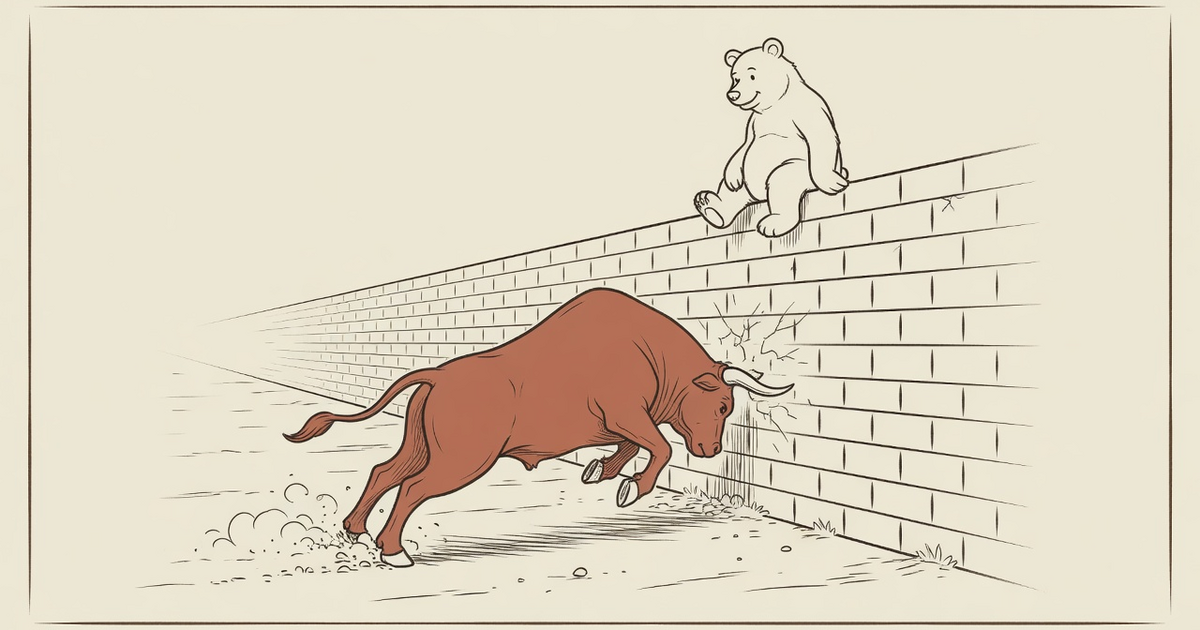
The bull market is six years old — one of the longest on record. A whole generation of investors has never once watched their account bleed for months on end.
This is for them.
Mostly for people who own stocks, but if you hold long-dated bonds, gold, or any kind of fund, you’re on the hook too. And if you think none of this touches you because your fund manager — or your advisor, or that friend who “really knows markets” — will handle it for you, do yourself a favour and read a history of hedge funds first. You are strolling, cheerfully, toward a very expensive lesson.
Here’s the uncomfortable part. If you’ve never traded through a bear market, you don’t actually know anything yet. Not about yourself, not about your own decisions, not about whether the system you’re so proud of even works. A bull market tells you nothing. It flatters everyone equally.
Because the real job of a bear market — its function inside the whole machine — is to move money. And you can probably guess which way it flows: out of a great many small hands and into a few large ones. For the system that’s healthy. The panicky, unpredictable players get cleared out and steadier, more experienced ones take their place, and the whole thing grows more stable. Cold comfort when you’re the one being cleared out, I know. But understand the point: a bear market is not the bull market breaking down. It’s a working organ of the thing. Take it away and the system rots.
When does the next one come?
I have no idea. Neither does anyone selling you a newsletter. It could show up next week or in five years; both are unlikely, and the truth sits somewhere in between. The timing isn’t the point. The point is that it is coming, with total certainty. If you’re new at this, bookmark this page and reread it every three months until the bear arrives. When it does, you’ll be very glad you did.
So what does the bear know that you don’t?
How to fool you completely. Its “aim,” by the time it actually arrives, is to have you sitting in the largest position of your life, grinning, clapping like a seal. I’ll say it plainly: you will hold more shares than you did at the bottom, more than your average all the way up the climb. And you will be thrilled about it.
How does it pull that off? I can’t give you the exact route — I still haven’t grown the organ that sees the future — but we know its old tricks well enough.
Take the first. It simply rises, and keeps rising, with no correction worth the name, throwing off fatter and fatter returns. At first you smirk: nice try, but you won’t catch me. Then the weeks pass and you start to squirm. You wait for a pullback. You wait for a smaller pullback. You stare, furious, at the run you’ve already missed. And then the pot-bellied taxi driver next door tells you what he cleared on some fund and how the whole family’s off to Thailand — and something in you snaps. One fine spring morning you can’t take it any more and you put the money in. A little, at first, carefully. Then you realise how much you “lost” by holding the rest back, so in goes every last scraped-together dollar of it. And you’re happy. Amen. Now the bear can begin.
You’re thinking: not me. You’ve read a hundred stupid stories like this. You know that when they start talking stocks at the cocktail party, you head for the door. So go — why are you still reading this tired old nonsense? Go find yourself some cat pictures, because if you keep going you’re only going to learn what a mark you are, same as everyone else.
Still here? Fine. Let me tell you a story.
Stanley Druckenmiller. Less famous around here than the Hungarian-born George Soros — but only because Soros’s marketing operates in a different league. Druckenmiller ran Soros’s Quantum Fund through its golden years, compounding roughly 30% a year. The legendary short of the British pound in 1992 was his idea; Soros’s real contribution was to say, in effect, now size it up — and it netted the fund over a billion dollars. Druckenmiller took the reins at Quantum in 1988, so he was hardly a rookie, and for twelve years he was about as good as anyone alive.
Then, in early 2000, he bought technology stocks at the very top of the mania — almost literally weeks from the peak — and handed Quantum a loss north of 20% in a matter of months. He’d even shorted tech a little earlier, in smaller size, and been burned for it. By his own account he knew, the entire time, that buying was a mistake. He simply stood and watched it climb until he couldn’t stand it any longer, and then he bought — billions of dollars of it, near the highs. Then he was gone.
Sit with that one. If one of the finest investors of the last century, running the best fund of its era, could be dragged into buying the top of a bubble he knew was a bubble, what exactly makes you think you’re the exception?
The market, naturally, is far too crafty to lean on a single trick. Braced for the melt-up now? Good. Here’s the other one.
It drops, hard, out of nowhere. You panic and sell. Then it grinds quietly back up, right up to the point where it’s talked you into climbing back in — and drops again. Panic, sell, and the loop starts over. Except after a few rounds you begin to feel you’ve got the thing figured. You stop flinching at the sudden drops. In fact you buy them, because they’re cheap. And there you are once more: fully loaded, grinning, waiting for the bounce.
Which means the bear can begin.
You won’t dodge it. That is the whole point of the place. The bear cannot arrive until the marks are stuffed full. So look around the table. How many marks do you count? If you can’t find one — it’s you.
There is exactly one way out of the trap, and you won’t like it: stop making decisions. More precisely, do exactly what you were doing all through the bull, and change nothing. If you held the simplest portfolio in the world and rebalanced it once a year, then you keep holding it and rebalancing it once a year — that’s all. Make it a permanent portfolio, or one of a thousand other setups; just cling to the plan you already had. Year-end, you rebalance; if there’s cash, you buy something in the set proportions; done. No extra moves, no cleverness. Don’t use ETFs? No problem. Say you held five or six funds in equal weight and topped one up now and then — you do precisely the same thing right through the bear. Momentum system? Follow its rules. Valuation-based? Follow that. The point is that nothing changes.
This is the moment it gets decided: whether you become an investor, or spend the rest of your life complaining about stupid markets. Carry your system through, untouched, and you’ve won the game. Fail to, and it means one of two things — the system was bad, or it was never the right one for you. That is the bear’s real work: pulling the broken systems out by the root. In a bull, almost nothing shows. Running up too many costs? There’s still return left over. Hopping mindlessly from one holding to the next? Doesn’t matter, everything’s rising a bit. Making bad calls and taking losses? Fine, just sit it out. As long as you live inside a bull market, nothing at all is revealed about you or the system you run. The verdict is only ever handed down by the bear. And it never softens it.
Understand this much: you do not get to pass the bear to someone else. It’s an illusion to think others will solve it for you. They’ll manage the money, they’ll offer the advice — and the pain will still be yours. Nobody can take it off your hands. Your money, your responsibility.
And you can’t run, either. If reading this has rattled you enough that you’re thinking you’ll just step out now, sit in cash, and stroll back once the next bear has come and gone — wonderful plan. Truly. Except you’ve understood none of it. I promise you’ll be right back in, loaded to the eyeballs with stocks and whatever else, grinning, exactly as the bear folds its arms around you. There’s no side door. One road only: you carry your system through the bear, or you get out now, for good.
Think it over properly. There’s a fair chance you’re just one bull market away from finding out which of the two you are.
