The Rats That Learned to Be Smart
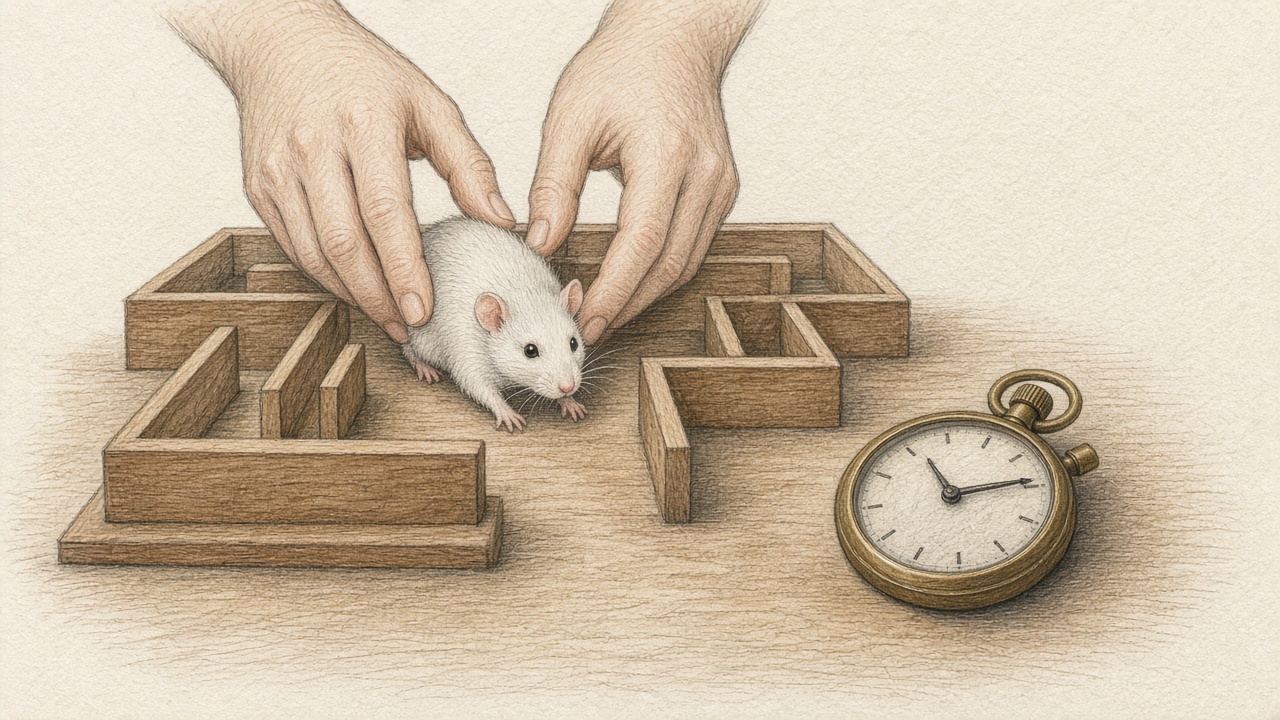
In the spring of 1961, twelve undergraduate psychology students at the University of North Dakota were handed sixty ordinary lab rats and a stopwatch.
Half of the students were told their animals came from a lineage bred for intelligence. These were “maze-bright” rats, selected over generations to solve spatial turns with ease.
The other half were told they had drawn the duds. These were genetically “maze-dull” animals, slow to learn and quick to give up.
The labels were pure fiction.
Every rat had been picked at random from the same commercial stock of standard albino lab animals. There was no genetic difference between the cages.
Yet over five days of trials in the wooden mazes, the bright group learned much faster. They made fewer errors, and they reached the food goal more consistently. By the final day, the supposedly gifted rats were outperforming the dull ones by nearly two to one.
Robert Rosenthal and Kermit Fode published the results in 1963. The paper established what became famous as experimenter expectancy.
How does a human thought cross a wire cage?
A rat does not read the index card taped to its housing. It has no ego to flatter and no reputation to protect. If the genetics were identical, the difference had to travel through the only point of contact connecting the student to the animal: the physical handling.
Rosenthal and Fode surveyed the students after the runs. The students who believed they had bright rats reported that they handled them more gently. They stroked them more often. They described the animals as relaxed, pleasant, and clean.
The students assigned dull rats reported the opposite. They handled them abruptly, and they found them clumsy and unpleasant to touch.
I think the physiology here is straightforward. When an anxious handler grabs a rat roughly, stress hormones surge. A frightened rodent freezes at the first fork in an alley, while a calm animal explores the corridor and finds the food.
Expectation did not rewire the rats’ brains. Handling did.
That distinction was quickly lost in transit. Five years later, Rosenthal teamed up with Lenore Jacobson, an elementary school principal in California, to test the same idea on children. In Pygmalion in the Classroom, they reported that pupils falsely labeled as intellectual “bloomers” produced dramatic IQ gains eight months later, especially in first and second grade.
Education embraced the book with open arms. It offered an intoxicating promise. Teachers could raise intelligence simply by holding generous beliefs. If you expected brilliance, the child’s raw mind would expand to match your faith.
That romantic leap skipped a serious flaw in the data.
When psychometricians checked the numbers, the study fell apart. Robert Thorndike showed in 1968 that the test they used—the Flanagan Tests of General Ability—had virtually no floor validity for six-year-olds. Raw test noise had generated absurd scores. One child’s reasoning score had supposedly jumped from an impossible IQ of 17 to a post-test score of 148.
In 1971, Janet Elashoff and Richard Snow reanalyzed the raw data in Pygmalion Reconsidered. Once scoring errors and extreme outliers were cleaned out, the miraculous jump in IQ vanished.
Later evidence closed the book on the mental telepathy story. Stephen Raudenbush’s 1984 meta-analysis showed that planted expectations produced an effect only when teachers had known pupils for less than two weeks. Once a teacher spent more than a fortnight with a real child, external labels had virtually zero impact. Classroom reality rapidly wiped out the fake label.
Decades of research by Lee Jussim confirmed that teacher expectations correlate with student achievement mainly because teachers are accurate observers of actual ability. When true self-fulfilling prophecies do occur, their effect is modest, typically hovering around correlations of 0.1 to 0.2.
Belief alone does not teach long division.
What survived from that North Dakota lab is narrower and far more practical. Rosenthal later framed it as a four-factor model: Climate, Input, Output, and Feedback.
Expectations change results only when they turn into concrete actions.
A teacher who expects competence smiles more warmly. They assign more demanding work. They wait longer for an answer before jumping in, and they offer detailed, constructive critique instead of vague praise.
Without those physical acts, the warmest private hope changes nothing.
In parenting and schooling, we often get this backwards. Parents are told that expecting brilliance produces a prodigy, which turns normal learning struggles into guilt. If a child falls behind, parents wonder whether their own belief was too weak.
The 1963 rats tell the opposite story.
The students did not project intelligence through the air. They delivered calm through their fingers. The animals that learned were the ones given gentle handling, unhurried time, and repeated chances to run the maze without being dropped in frustration.
If you want better performance from a child, an employee, or a student, auditing your internal faith is a waste of time.
Audit your hands. Count how much wait-time you grant before interrupting. Check the difficulty of the tasks you assign. Measure the patience of your feedback.
Expectation is an idle daydream until it becomes an instruction.
