The Clock in the Freezer
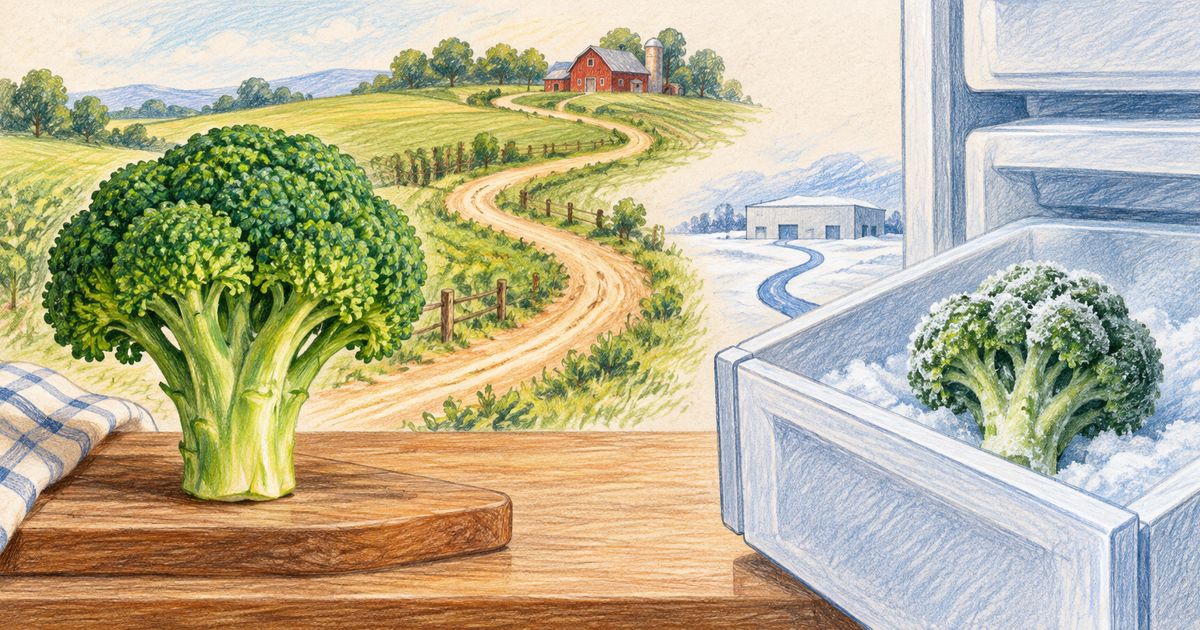
Is a frozen vegetable as healthy as a fresh one?
That sounds like a question about temperature. It is also a question about time. Are we comparing a pea just picked from the plant with a frozen pea, or a pea that has travelled, sat in a shop, and waited in a refrigerator?
Researchers once put eight kinds of produce through a more useful contest. They measured selected vitamins in fresh, frozen, and fresh produce kept in a refrigerator for five more days. Most comparisons showed no significant difference. Where a difference appeared, the frozen produce beat the stored fresh produce more often than the reverse.
That does not make the freezer a vitamin factory. It makes the word fresh a poor stopwatch.
The fresh vegetable keeps changing after harvest. Some of its compounds decline while it waits for us. Freezing slows that process, though the frozen version has its own bill to pay before it gets there. Many vegetables are briefly heated, or blanched, before freezing. This disables enzymes that would damage quality in storage, but heat and water can also take away some sensitive vitamins. Berries often skip that step.
The two sides can both be right about the same bag of vegetables. Blanching can cause an early loss, and frozen storage can prevent a later one. Whether the trade comes out ahead depends on the crop, the compound, and how long the alternative fresh crop sits around. I would distrust any single percentage offered as the answer for every vegetable.
Broccoli makes the problem sharper. In one analysis, industrially processed broccoli lost some vitamin C and phenolic compounds while retaining its glucosinolates, the family that includes a precursor to sulforaphane. A label showing that precursor would seem reassuring.
Then comes the missing step. Broccoli uses an enzyme called myrosinase to help turn that precursor into sulforaphane. Commercial blanching can disable the enzyme. In a small human experiment, lightly cooked soup made with fresh broccoli produced roughly ten times more available sulforaphane than soup made with commercially frozen broccoli. The researchers traced the gap to the lost enzyme.
That is a real difference. It is not evidence that fresh broccoli makes people ten times healthier, or that frozen broccoli is useless. The experiment measured uptake of one compound from one preparation, not years of illness or wellbeing. Other nutrients remained. In my view, this is exactly why “same nutrients” and “same effect in the body” should not be used as synonyms.
The kitchen gets a vote too. Boil either version for a long time and pour the water away, and some water-soluble nutrients go with it. A shorter cook with less water may preserve more. The texture will still differ: a frozen berry is rarely the best stand-in for a fresh one on a plate. Texture, though, is a different verdict from nutrition.
So are they equivalent? As a way to put fruit and vegetables into an ordinary diet, plain frozen produce can be a sound substitute for fresh, especially for produce that would otherwise spend days in the fridge. It is not an identical chemical copy. If you want a specific compound from a specific food, the processing and cooking details matter. If your fresh alternative is likely to spoil before dinner, that matters too.
