Go to Bed Early, Stay Stupid
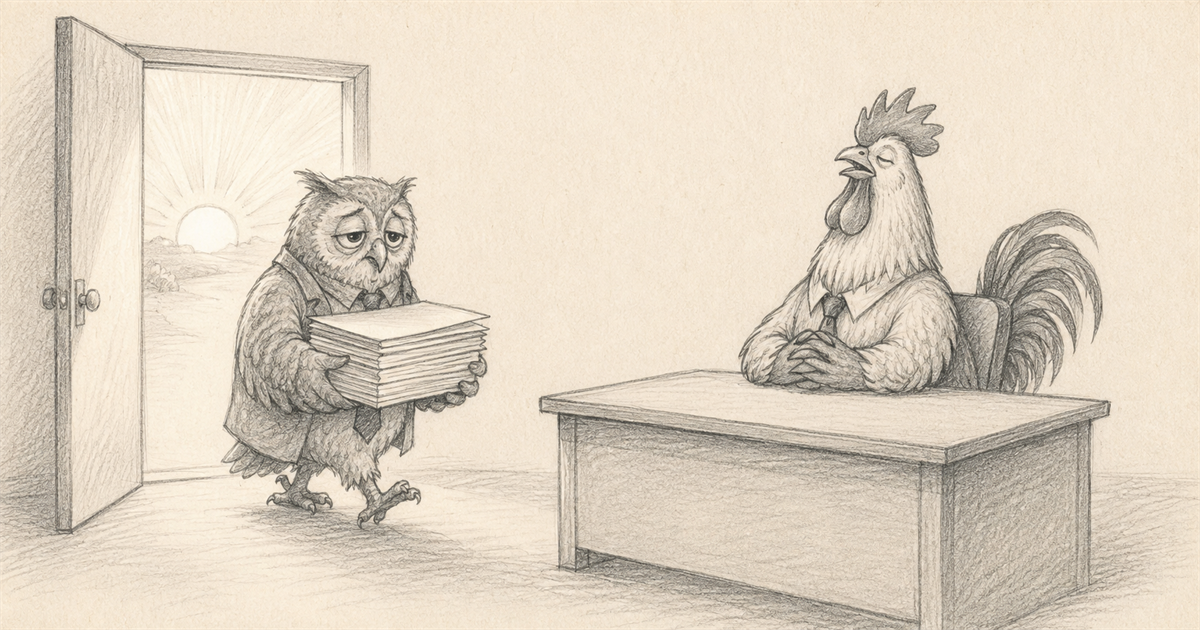
I rarely go to bed before two in the morning. I am a proper night owl. This would be an excellent trait if schools, offices and children had agreed to begin the day around lunch.
They have not.
Children wake early. School starts early. Arriving at work after everyone else may be efficient, but it does not photograph well. A person who leaves at four is disciplined. A person who arrives at ten has “an interesting schedule,” even if both worked the same hours.
My wife has a shorter diagnosis: “You sleep through our life.”
The medical literature is not much kinder. If an article about night owls appears in front of me, it usually finds space to mention depression, diabetes, bad habits and an earlier death. One UK Biobank study of about 433,000 adults found that definite evening types had roughly a 10 percent higher risk of dying during the follow-up than definite morning types. It was an observational result, not a death sentence, but nobody puts that in the headline I am trying to avoid.
There is a lot wrong with this way of life.
Until now.
Science has finally caught up with the question that science should have examined first: what if staying up late is not a defect but a visible symptom of superior intelligence?
The answer arrived in a paper with the admirably unambiguous title “Why night owls are more intelligent.” Compared with this discovery, relativity was useful preliminary work.
I knew it.
The researchers used a large American longitudinal study. They took a verbal-IQ measure from adolescence and compared it with reported sleep times years later, when the participants were young adults. The pattern moved in the correct direction. The lowest cognitive group went to bed at 11:41 p.m. on weeknights; the highest at 12:29 a.m. On weekends the gap stretched from 12:35 a.m. to 1:44 a.m.
This is enough evidence for all practical domestic purposes.
A complaint about getting up late? Here is the paper. Somebody at dinner asks why I go to bed at two? Here is the paper. Shall we continue this unpleasant conversation, or would everyone prefer an IQ test?
Unfortunately, scientists put words below titles.
The 2009 paper says its effects were very small. It measured verbal ability, not full general intelligence. Sleep times were self-reported. It showed that childhood IQ predicted slightly later schedules in early adulthood; it did not show that staying awake to watch one more episode makes anyone smarter.
An updated meta-analysis in 2021 combined 30 studies and 11,160 people. Across the full sample, morningness had no meaningful relationship with intelligence. Eveningness had a positive correlation of 0.056, tiny enough to require scientific instruments and a strong desire to find it. It reached significance only under some model choices.
The victory parade may need a smaller street.
Then a 2020 study compared 586 German Mensa members with 586 matched controls. The Mensa group slept later on workdays, which looked promising. But they did not have a later biological chronotype. Their later sleep was fully explained by something more ordinary: their jobs started later.
That result is less flattering and more interesting. Smarter adults may not be biologically compelled to contemplate the universe at 1:47 a.m. Some may simply have acquired work that gives them more control over the clock.
The privilege is not staying up late. It is being allowed to sleep when you do.
Chronobiologists call the gap between our biological schedule and our social schedule “social jetlag.” Late types tend to carry more of it because the world is built around the morning. We even attach moral meaning to the clock. In one workplace study, supervisors rated later starters as less conscientious and lower-performing after the researchers accounted for hours worked, objective performance and the employees’ own conscientiousness ratings.
The early bird does not merely get the worm. It writes the performance review.
This does not clear night owls of every charge. Chronic sleep loss is still chronic sleep loss. If I go to bed at two and the children wake me at seven, my body does not accept a journal article instead of the missing three hours. The health penalties may come partly from that mismatch, but “partly” is not “harmless.”
Nor does a late bedtime certify genius. The evidence allows for highly intelligent larks, unintelligent owls and every ordinary creature in between. This is bad news for my new identity card.
Still, the research rescues one useful point. Waking late is not proof of laziness, just as waking early is not proof of character. Sometimes the clock measures discipline. Sometimes it measures biology. And sometimes it measures who has enough control over life to tell the morning meeting to wait.
I will keep the paper ready for my wife. I will also make sure she never scrolls past the title.
If the authors receive an Ig Nobel Prize, I hope the ceremony starts after lunch.
