Four Cents for One
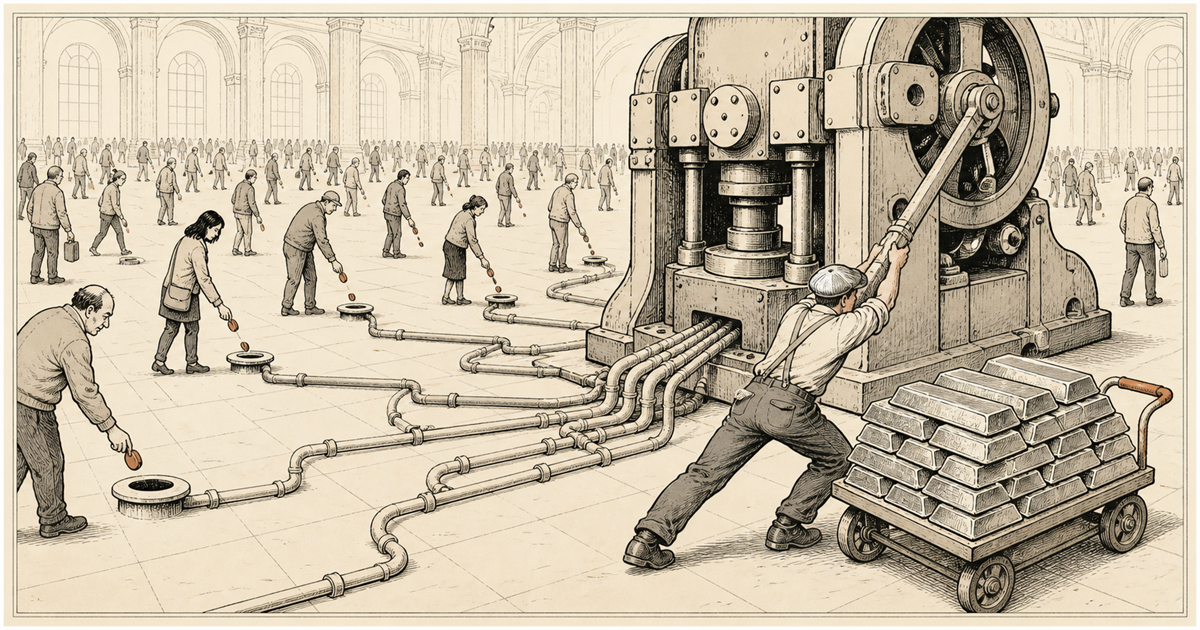
It costs the United States Mint about 3.69 cents to make one penny. You read that right. The government manufactures a coin worth one cent for the price of nearly four of them, and did it, at a loss, hundreds of millions of times a year, for decades.
That is not a rounding error. That is the whole coin being upside down.
The obvious question is why anyone kept doing it. The answer is more interesting than “bureaucracy,” because plenty of people inside the system knew the math. The penny survived anyway, and it survived for reasons that have almost nothing to do with the penny.
One reason is the zinc. Somebody supplies the metal, and somebody who supplies the metal would rather keep supplying it, and so there was a small, patient lobby whose entire job was to make sure the losing coin kept getting made. A tiny interest, tightly focused, beats a large interest that’s diffuse. Everyone pays for the penny; nobody pays enough to get angry.
The other reason is a fear dressed up as prudence: that without the penny, shops would round prices and the rounding would always go up, nickel-and-diming the poor. It sounds caring. Countries that actually dropped their smallest coin, Canada among them, rounded cash totals to the nearest five and the sky stayed put. The fear was real. The harm was not.
So the coin sat there, obviously absurd, costing more than it was worth, protected by a small lobby and a large superstition. In 2025 the U.S. finally called time and ordered the last of the blanks. The Treasury put the saving at around 56 million dollars a year. Sixteen years too late, give or take.
What I keep turning over isn’t the penny. It’s the shape of the thing.
The stuff that outlives its usefulness is almost never the important stuff. Important things get watched, argued over, reformed. The survivors are the items too small for anyone to bother killing. The pointless field on the form. The report nobody reads that three people still compile. The meeting that exists because it existed last week. Each one is a penny: costs a little, matters to almost no one, and sits there precisely because ending it would take more attention than tolerating it.
That is the trap. A thing doesn’t have to be defended to survive. It only has to be beneath notice.
The penny got seventeen extra years not because it was worth keeping but because it was too trivial to fight over. Somewhere in your own week is a penny doing the same thing, costing you four cents to make one, protected by nothing but the fact that you’ve never once stopped to add it up.
Go find it. It’s cheaper than you think, which is exactly how it hid.
