When does another dollar become a bad trade?
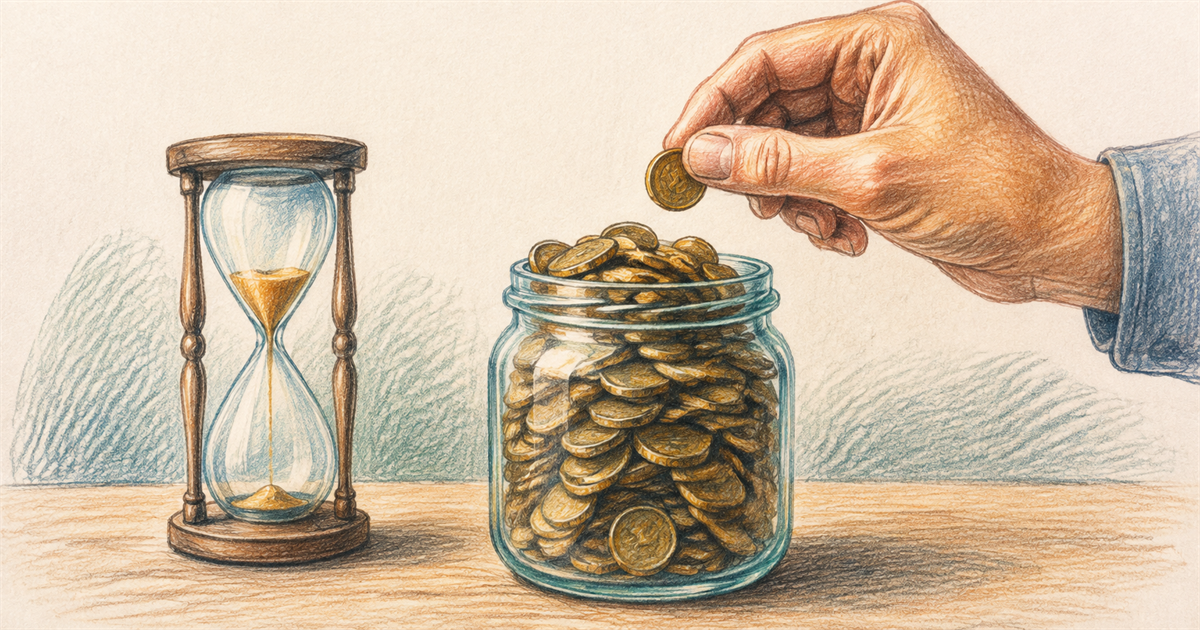
Enough is not a number. It is a rebalancing decision.
That claim needs attacking, because numbers are useful. A cash buffer changes the experience of a broken boiler. Savings let you leave a bad job, help a child, survive a recession, and sleep through a market crash without selling at the bottom.
Telling someone with no margin that money no longer matters is usually a sermon delivered from a very comfortable chair.
The evidence does not give us a universal finish line either. In 2023, researchers who had reached different conclusions worked together on the question. They found that emotional well-being generally kept rising with the logarithm of income.
The famous plateau appeared mainly among the least happy people. More money may matter less at the margin, but “less” and “nothing” are different words.
So the useful question is not when money becomes worthless. It is what you are selling to get the next unit of it.
We tend to treat money as the account that compounds and everything else as current spending. Work now, enjoy later. Miss this week, make it up next month.
We postpone the long trip until retirement, the afternoon with a child until the project ends, and the visit to our parents until the calendar behaves. The spreadsheet permits all of this because dollars are fungible. Tuesday is not.
That creates a strange asset-allocation problem. Money can be stored, transferred, invested, inherited, and spent years after it was earned. A particular summer cannot.
Health, relationships, and shared history may improve through repeated investment. Yet they do not accept unlimited catch-up contributions. The same hour has a different value depending on who is still alive, how old the child is, and what your body can still do.
This is more than diminishing marginal utility. It is a mismatch of clocks.
The financial account may have decades left to run while another asset is close to expiry. A promotion can be won at forty-eight instead of forty-six. Your daughter will not be ten again. You may take the mountain trip later, but later you will bring different knees.
Ambition is not the mistake. The mistake is valuing every opportunity with the time horizon of money.
The compounding metaphor can also flatter us into bad arithmetic. Relationships do not pay a guaranteed return because you logged the required number of dinners. Exercise does not put health points into a vault.
These assets are path-dependent rather than mechanical. Repeated attention preserves trust, capacity, and future choices. Neglect can remove choices. There is no promise of interest, only a shrinking set of possible tomorrows.
Money still has one remarkable advantage: it can sometimes be converted back into time. A 2017 study followed this question across 6,271 people in four countries. Those who paid for time-saving services reported higher life satisfaction.
A field experiment also found that working adults felt happier after a time-saving purchase than after a material one. I do not read that as an instruction to hire help. Many people cannot. I read it as evidence that wealth becomes most useful when it is allowed to serve the scarcer asset.
This is why “enough” should move. Early in life, money may be the binding constraint. Trading time for skill, savings, and a margin of safety can be an excellent bargain.
Later, the balance can reverse. The bank account becomes resilient while the remaining years with a healthy parent, a young child, or a capable body become fewer.
There is no age at which this switch must happen. No net-worth calculator can identify it. A person supporting a large family needs a different buffer from someone with no dependants.
Work can also be a source of friendship, craft, and meaning. If you love building a company, another year at the company is not automatically a year stolen from life. The same sixty-hour week can be chosen work for one person and expensive avoidance for another.
I think the practical test is marginal. What does the next dollar buy, and what must be sold to earn it?
If it protects your family from a real shock, its value may be enormous. If it changes a scoreboard while consuming an event that cannot recur, the trade has changed even if the salary has not.
Mohamed El-Erian encountered that trade while running PIMCO, then a roughly $2 trillion investment firm. His ten-year-old daughter gave him a list of twenty-two events he had missed in one school year. It included her first day of school and her first soccer game.
He later described the list as a shock and a turning point. It would be too neat to claim it was the sole cause of his 2014 departure. Contemporary reporting also described conflict inside the firm.
But her list exposed the accounting error. His professional capital was visible, measured, and still compounding. The missing entries were in an account that could not be audited later.
For that trade, enough arrived when he saw which asset was running out.
