The Seatbelt's Mileage
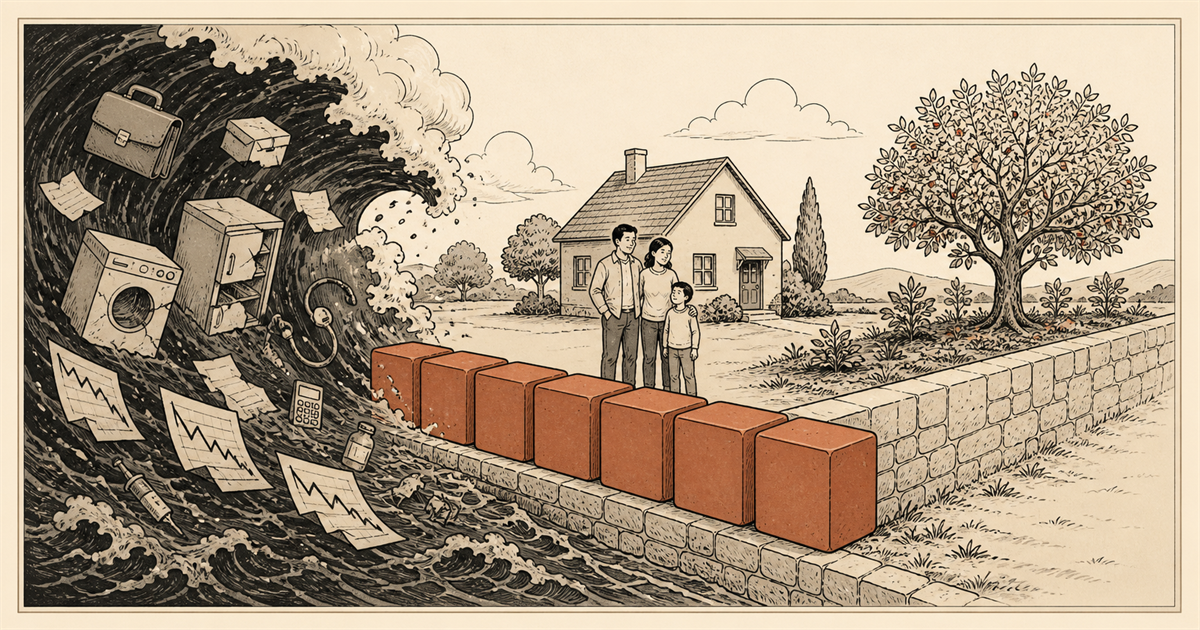
Picture losing your job in the same month the stock market falls thirty percent. It happens, because the two tend to arrive together: the recession that costs you your income is the same recession that craters your investments. Now the rent is due, the fridge is empty, and the only money you have is the money you did the responsible thing with, invested. So you sell. You sell at the bottom, into the crash, crystallising a loss that took years to build and may take years to undo, not because you misjudged the market but because you had to eat. That single forced sale, made at the worst possible moment for the worst possible reason, can quietly destroy more wealth than a decade of good decisions built.
And the thing that would have saved you from it is the one thing the smart money keeps telling you to get rid of. Cash is trash, they say, and even Ray Dalio has said it: cash earns almost nothing, inflation nibbles it away, so surely every spare pound belongs in the market, working. For money you genuinely won’t need for ten or twenty years, that’s simply true, and I’ll come back to how true. But applied to your emergency fund, to the buffer that stands between you and that forced sale, it is one of the most expensive pieces of clever-sounding advice going, and the reason it’s wrong is a category error hiding in plain sight.
Judging a cash buffer by its interest rate is like judging a seatbelt by its fuel economy. It’s the wrong axis entirely. A seatbelt is not there to improve your mileage; a buffer is not there to grow your money. Its whole purpose is protection, and its value shows up precisely on the days a return calculation can’t see. So ask the right question, not “what does this cash earn?” but “what does not having it cost?” And the answer is enormous. It costs you the forced sale we started with. It costs you the twenty-four percent on the credit card you’d otherwise reach for when the boiler dies, or the several-hundred-percent annualised rate of a payday loan, a single episode of which can wipe out years of the yield you were so worried about missing. Measured against those, an emergency fund earning four percent isn’t underperforming. It’s the highest-return financial decision most people will ever make; it just pays out in disasters averted rather than interest earned.
This is the confusion the slogan smuggles in: money does two completely different jobs, and “cash is trash” applies the logic of one to the other. One job is long-horizon growth, money you won’t touch for decades, where you want every pound compounding and cash really is a slow loss. The other is short-horizon safety, money that has to be there, in full, on a bad day, where the point is not growth but certainty. Treating your safety money like your growth money is how you end up selling shares to buy groceries. They are not the same money and must not be run by the same rule.
Once you hold that distinction, the practical questions answer themselves. First, the order of operations, which is not a matter of taste. Clear your high-interest debt before anything else, because paying off a card at twenty-four percent is a guaranteed twenty-four percent return, larger and safer than any the market offers; investing while carrying that balance is borrowing at twenty-four to chase seven, which is not a strategy, it’s a leak. Then build the buffer. Then, and only then, invest the surplus for growth.
Second, how big the buffer should be, which depends not on how much you have but on how volatile your income is. The old rule of three to six months of essential expenses is a decent start, but the real variable is simpler: how long would it actually take you to replace your income if it vanished tomorrow? A two-earner household with stable jobs in different industries can lean toward the low end, because both incomes disappearing at once is unlikely. A single earner in a narrow field where the job hunt runs months needs more. And the self-employed need most of all, closer to a year, because their bad month and the wider recession are the same event, their own downturn arriving exactly when new clients become scarce. Size the buffer to your life, not to a magazine’s round number.
Now, I promised to be fair to “cash is trash,” and for long-horizon money it is genuinely, powerfully right. Over any twenty-year stretch in more than a century of data, shares have never once lost to cash in real terms, and the premium they’ve paid for the ride, a few percent a year above safe assets, is about as robust a finding as finance has. For money you truly won’t touch for a decade or more, sitting in cash is a near-certain slow loss, and the enthusiasts are correct to be scathing about it. They’re also right about one thing that catches a lot of careful people: there is no reason on earth to let your buffer rot at zero percent in a current account when a safe, instant-access savings account or a money-market fund will pay you several percent for exactly the same risk. That part isn’t a category error, it’s just leaving free money on the table. Keep your buffer safe and liquid, yes, but keep it somewhere that pays.
Which points at the real danger on the other side, the one the “cash is trash” crowd is genuinely warning about, and it deserves respect too, because you can hold too much. An oversized cash pile, two years of expenses parked for a decade, is a real drag, quietly bleeding a quarter of its purchasing power to inflation while it waits. And a lot of that over-holding isn’t caution at all, it’s a bet in disguise. “Dry powder,” people call it, cash held back to pounce when the market dips, and it sounds shrewd, but it’s market timing wearing a sensible coat. A buffer has a defined size and a defined trigger, job loss, a broken car, a medical bill; you spend it on the emergency and refill it, and otherwise leave it alone. Dry powder has neither a size nor a trigger, just an open-ended promise that you’ll somehow know the right moment to buy, which is exactly the delusion that keeps people sitting in cash through the recoveries that produce most of the market’s long-run gains. The buffer protects you; the dry powder just costs you, and the two feel identical from the inside, which is why naming the difference matters.
So the whole thing resolves into avoiding two mirror-image mistakes, and which one you’re prone to is mostly a matter of temperament. Hold too little and you’re one bad month from expensive debt or a fire-sale of your investments, the error of the overconfident, who can’t bear to see money sitting “idle.” Hold too much and you’ve become a permanent market-timer who never quite invests, paying the slow tax of inflation for the feeling of safety, the error of the anxious, for whom no buffer is ever quite big enough. The target is a boring middle: enough to cover a real shock, sized to your own income, kept somewhere safe that pays a fair yield, and then not a penny more sitting in cash pretending to be prudent.
There’s a last reframe worth keeping, because it fixes the emotion that makes people get this wrong. A cash buffer is a kind of insurance you’ve written on your own life, and like all insurance you pay a small premium, here the modest drag of inflation, for the right to avoid a catastrophe. It also quietly funds options that never show up in any yield: the freedom to quit a job that’s grinding you down, to walk away from a bad deal, to take a swing at something of your own, precisely because you can absorb a few months of no income without it becoming a crisis. And the correct feeling to have about it, at the end of a year in which nothing went wrong and it just sat there earning its unspectacular four percent, is not disappointment that it “underperformed” the stock market. It’s the same quiet satisfaction you feel about a fire you never had, an insurance policy that expired without a claim. You hope your buffer is money you never have to touch. That isn’t the money failing to do its job. That’s the money doing it perfectly.
