Where the Grass Gives Way
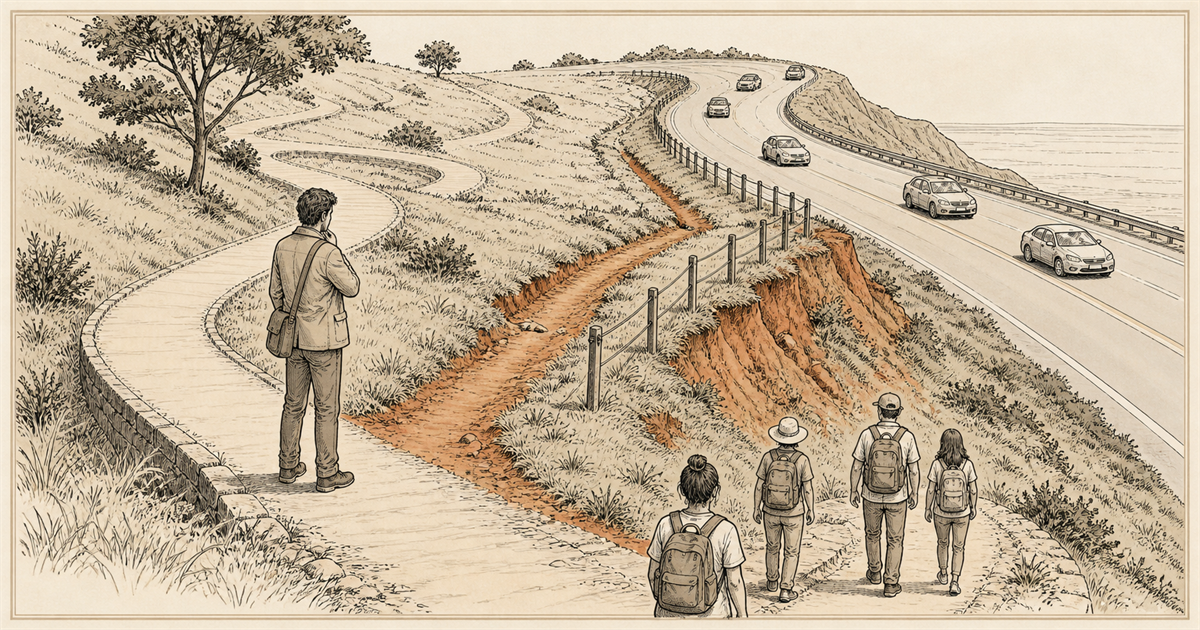
There is a spot on my walk to the station where the pavement makes a polite right angle around a patch of grass, and nobody takes it. The grass has a brown stripe cut straight across the corner, the width of one shoe, packed hard by years of people doing the obvious thing instead of the designed one. I’ve walked that stripe a thousand times without thinking. Lately I can’t stop thinking about it.
The planners call it a desire path. I like that the name admits defeat. Somebody drew the sensible route, poured it, edged it, and the public looked at the sensible route and said, no thanks, and voted with their feet every single day until the lawn surrendered.
You see them everywhere once you notice. The shortcut through the campus quad. The gap worn in a hedge. The dirt line that cuts the switchback because who has the patience for a switchback. Each one is a small, honest referendum, and the pavement almost always loses.
What gets me is the two ways of responding to it.
One response is the sign. Keep off the grass. A little fence. Maybe, if the planner is really committed to being right, a hoop of low railing that you now have to step over, which people do, because the path was never the problem. The sign treats the worn line as vandalism. It says: the design is correct and the humans are wrong, and the humans will be corrected.
The other response is humbler and, I think, smarter. The best landscapers have been known to lay no paths at all for the first season. They let people cross the space however they like, watch where the grass dies, and then pave the lines that appear. They let the users draw the map. Then they build it.
I find that second approach almost unreasonably wise, and I’ve been asking myself why we so rarely manage it.
Because it isn’t really about lawns. I sit in meetings where someone has designed a process, a form, an approval chain, a “correct way” to do the thing, and I watch everyone route around it. They email the person directly instead of filing the ticket. They keep the real numbers in a private spreadsheet because the official system is a switchback. And the standard reaction, every time, is the sign: a memo reminding people to use the proper channel, a new rule to enforce the old rule.
I’ve written that memo. That’s the part I can’t get past. It felt like enforcing standards. It was mostly me refusing to read the worn line.
Let me argue against myself, because the sign isn’t always wrong. Sometimes the shortcut really is worse and the fence really is protecting something: a slope that erodes, a road you’d cut across and get hit on, a control that exists for a dull reason that matters exactly once a year. Not every desire path should become a road. Some of them lead off a cliff. The planner sometimes knows a thing the walker doesn’t.
What survives that objection, for me, is smaller but firmer. The worn line is data either way. It is people telling you, without being asked and without any reason to lie, where they actually want to go. You are still free to overrule them. You are not free to pretend they didn’t speak.
So I’ve started trying to ask the duller question before I reach for the sign. Not “how do I get people to use the path I built,” but “what is the stripe in the grass telling me, and can I just pave it?”
I’m not good at it yet. My instinct is still to defend the design I already poured. But I walk that brown stripe every morning now, and it has become a small daily lesson in who was right. Not the person with the plan. The thousand people with the shoes.
