The Ten Thousand Hour Alibi
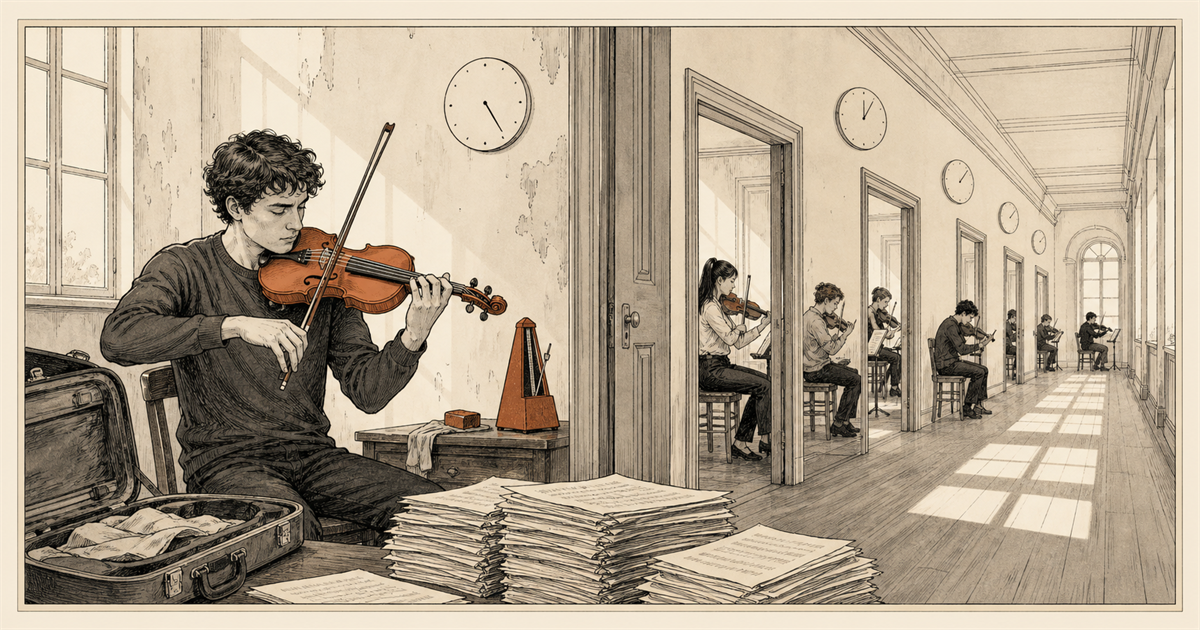
One camp says talent is a myth and greatness is just hours: put in ten thousand of them, correctly, and mastery follows. The other camp counts the hours, runs the numbers, and finds that they explain only a sliver of who ends up great. Both are looking at the same violinists, the same chess players, the same athletes. They walk away with opposite lessons.
That is a real disagreement, not a strawman, so it is worth refereeing properly.
The first camp has the better story. It comes from a study of violinists at a Berlin music academy, made famous when Malcolm Gladwell turned it into the “10,000-hour rule.” The best players had logged far more solitary practice than the good ones. The message was democratic and thrilling: the ceiling isn’t in your genes, it’s in your calendar. Anyone willing to grind can get there. Teachers loved it. So did parents. So did anyone who wanted to believe effort was destiny.
The second camp has the better arithmetic.
In 2014 a team led by Brooke Macnamara pooled 88 studies of practice and performance across music, games, sports, education, and the professions. They asked a blunt question: across all these people, how much of the gap between the great and the ordinary does deliberate practice actually account for?
The answer was about twelve percent.
Not zero. Twelve. And it swung wildly by field. In games, practice explained around a quarter of the difference. In music, a fifth. In sports, less. In the professions, close to nothing. The hours mattered most where the game is closed and rule-bound, and mattered least where the world is messy and open, which is to say, most of real life.
So who wins?
Fairness here is not a fifty-fifty split. The evidence lands harder on one side. The strong version of the ten-thousand-hour rule, the one that says hours are basically all of it, does not survive the data. Something else is doing most of the work: starting age, the body you were dealt, working memory, coaching, health, luck, and the plain fact that some people improve faster per hour than others. Two people can practise the identical ten thousand hours and finish nowhere near each other.
But the opposite slogan is just as false, and I want to be clear about that. “You either have it or you don’t” is lazy and usually self-serving. Nobody reaches the top of anything on talent alone; the practice is necessary even when it isn’t sufficient. Take the hours away and the gift goes nowhere.
My verdict: practice is the price of admission, not the deed to the house. You cannot get in the door without paying it. Paying it does not mean you own the place.
And the comfortable version of the rule does a quiet cruelty I dislike. If hours are everything, then everyone who fell short simply didn’t want it enough. That turns talent, timing, and luck into moral failings. It hands the successful a flattering story and hands everyone else the blame. The data says the world is less fair than that, and pretending otherwise mostly serves the people who already made it.
Here is the part I can’t settle, and won’t pretend to. If practice is the twelve percent you control and the rest is mostly given, what is the honest thing to tell a kid at the start? “Work hard, it’s necessary but not enough” is true and deflating. “Work hard, you can be anything” is false and motivating. I lean toward the true one. I also notice that the false one has produced a lot of people who got further than the truth would have let them try.
Maybe that is the real trade the rule was making all along. Not accuracy for inspiration, but a lie that gets some people out of bed against a truth that talks others out of it.
I don’t know how to price that. I only know which one the evidence supports, and it isn’t the one on the poster.
