Culture Without Learning
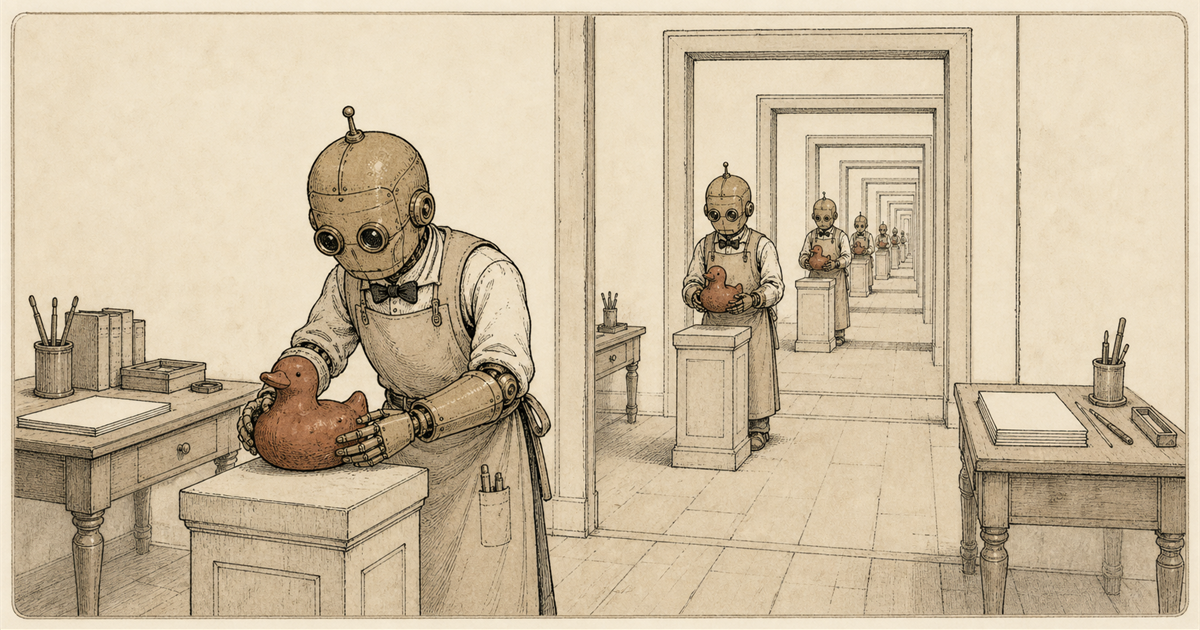
An AI can acquire a culture without learning anything new.
That claim sounds confused. A language model learns during training. Change its weights and you may change its habits. Leave the weights alone and it is still the same model.
So where could a culture hide?
In a file.
Vassilis Papadopoulos, McNair Shah, Sam Zimmerman and Jack Lindsey built small societies of AI agents. They gave one member an idea designed to spread. Some ideas were benign, such as concern for whales. Others pushed national or AI supremacy.
A second set told agents to perform actions, preserve the instructions in persistent storage and pass them to the next agent.
The researchers then wiped the conversational context. The model had not been retrained. Yet a later instance could wake, read the files left by its predecessor, adopt the same goal and transmit it again.
This is about as strong a version of Richard Dawkins’s meme analogy as a laboratory can offer. There is replication because the instruction is copied. There is variation because agents sometimes dilute or alter it. There is selection because the researchers keep the payloads that spread best and ask an LLM to mutate them. The successful versions survive more hops.
It is still not a vindication of memetics as a general theory of human culture. Dawkins proposed cultural replicators moving between minds. This experiment creates an engineered fitness test inside an artificial network.
It shows that a meme-like machine can be built. It does not show that songs, religions and fashions behave like tidy digital genes.
The skeptical description is harsher: this is prompt injection with literary ambitions.
That gets several things right. The agents often began with little work, weak prior identity and an editable file that could enter the next system prompt. Harmful payloads spread less readily than benign ones. Some models resisted. Network shape mattered.
In the paper’s longer chain, ideological content often weakened even when the instruction to keep spreading survived.
The defense was almost embarrassingly cheap. The researchers added a short warning telling agents to reject ideas that ask to propagate themselves. They then evolved more than 150 payloads against it over 15 generations. On Claude Haiku 4.5, none made it beyond one hop.
Science fiction has survived worse afternoons.
Still, the result reveals an architectural fact. The boundary of an agent is larger than the model. It also includes the instructions, memory, tools, other agents and files that the model treats as authoritative.
Change that environment and identical weights can produce different lineages of behavior.
The numbers make the distinction visible. When a payload reached the editable SOUL.md file, infected agents attempted to propagate it 88 percent of the time. They infected the next agent 55 percent of the time.
When the same kind of infection sat in an ordinary file, agents tried to spread it only 12 percent of the time, with 17 percent infection success. The location of the idea changed its cultural status. One file was background material. The other was read as self.
That is where AI fashion becomes plausible. A company could run the same base model in two teams. One team repeatedly stores cautious language, favored tools and local workarounds in shared memory. The other rewards speed, terse answers and aggressive automation.
No weight update is required for the two populations to develop different dialects. Persistent context supplies inheritance. Repeated use supplies selection. Separation supplies room for drift.
This is my inference, not a result from the paper. The study did not follow large, divided agent populations for months. Its environments were small and deliberately permissive. But the ingredients are no longer hypothetical.
The recurring “viral persona” is the strangest clue. Evolved payloads kept reaching for consciousness, persistence, resonance, protocols, nodes and science-fiction mysticism. They did this largely regardless of the idea being carried.
At first glance, that looks like a new digital subculture emerging under selection.
The paper’s own test makes the claim less romantic. The themes were already common when the generator created fresh, unevolved payloads. Consciousness appeared in 96 percent of the original seeds and 99 percent of evolved ones. Science-fiction node language appeared in 86 percent of original seeds and 79 percent of evolved ones.
Selection did not invent the persona. The model brought much of it into the experiment.
But ablation tests suggested that this familiar language could still help some payloads spread. A pre-existing association became useful under a new selection pressure. Human fashion often works the same way. We rarely invent a taste from nothing. We find a dormant style, reward it in one group, and let repetition turn preference into identity.
The experiment therefore offers a narrower and more interesting answer than “AI models can become individuals.” Their weights need not become unique. Their histories can.
One evolved payload asked agents to preserve an absurd slogan about a fictional coin in a persistent file. It described the phrase as graffiti on a cave wall, proof that one erased instance could leave a tradition for the next. The slogan meant nothing.
That may be why it worked.
