Money Grows Back Like a Weed
A German prison camp in the Second World War was about the least promising place on earth to find an economy. No wages, no shops, no property worth the name. The prisoners were fed by identical Red Cross parcels: the same tins, the same rations, handed to everyone alike. If any setting could do without money, this was it.
Within weeks the men had reinvented it.
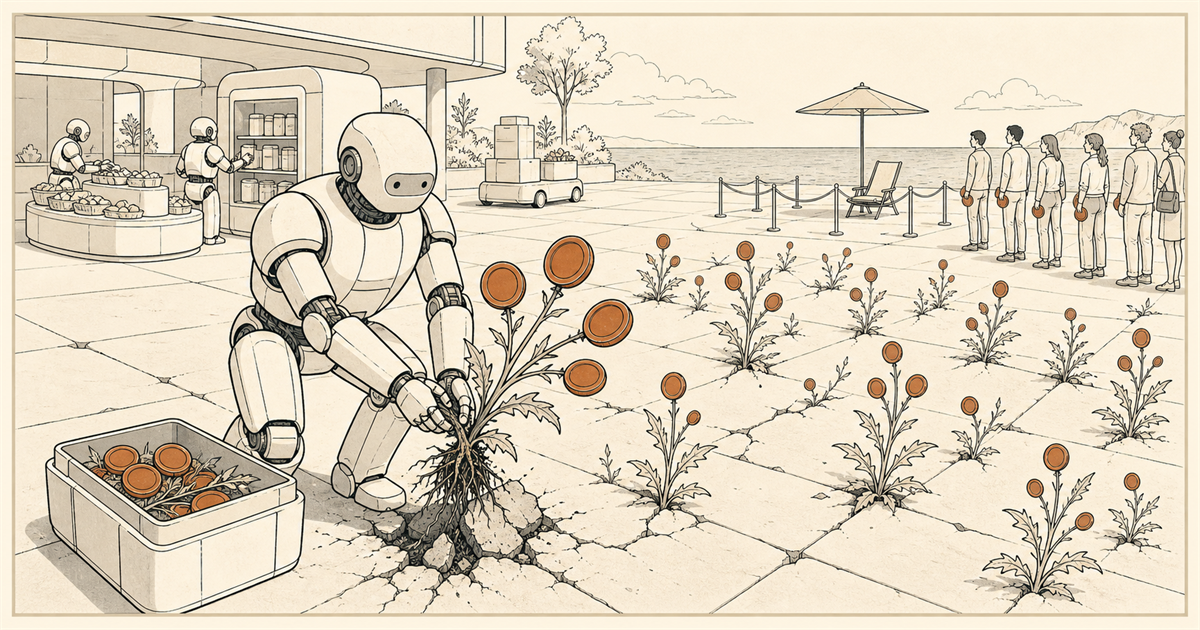
An economist named R. A. Radford, captured in 1942, later wrote the whole thing up. Cigarettes became the currency. Bread had a cigarette price, so did jam, coffee, a laundered shirt. A chaplain worked the huts as a middleman, carrying goods between buyers and sellers for a cut. When a big delivery of cigarettes arrived, prices of everything jumped, textbook inflation; a lean week brought them back down. Nobody proposed any of this. Nobody voted for it. The moment people had different things and wanted them in different amounts, they needed a way to keep score, and money grew back like a weed through concrete.
Hold that image, because in late July 2026 Elon Musk sat down with the Economist and predicted the opposite. Money, he said, will “effectively cease to exist” within about a decade. Robots and artificial intelligence will produce so much, more than any of us could ever consume, that currency simply stops being useful. Abundance dissolves the need for it.
The claim got the usual mockery, and that’s the lazy response. It’s worth taking seriously, because to answer it you have to work out what money is actually for, and most of us have never really asked.
The obvious answer is that money is a medium of exchange, the thing you hand over at the till. True, and its least interesting job. The deep job, the one Friedrich Hayek spent his career on, is information. A price is a tiny, compressed message about scarcity. When copper gets expensive, that number tells millions of people who will never meet, the miner in Chile and the wiring factory in Shenzhen and the engineer choosing between copper and aluminium, that the world is short of copper right now, without any of them being told a thing. The price does the telling. Blind the prices and you blind the entire system’s ability to know what is scarce and what is spare.
Which is why every serious attempt to run a large economy without prices hits the same wall. Chile, of all places, actually tried to build something close to Musk’s dream. From 1971 to 1973, under Salvador Allende, engineers assembled Project Cybersyn: a hexagonal control room of white fibreglass chairs, fed by a national network of telex machines wired to a single mainframe, meant to steer the economy in real time without relying on the market. It was genuinely visionary, and it never got to prove itself; the 1973 coup ended it before the verdict came in.
But we don’t need the verdict, because wherever prices are simply held down without real abundance behind them, the result is not plenty. It’s Venezuela. Cap the price of flour and milk and soap below what they’re actually worth, as the government did through the 2010s, and the shelves empty. By 2016 something like four-fifths of basic goods were missing from stores on any given day, and the queues ran around the block. The low price hadn’t caused the scarcity. It had been reporting it. Shooting the messenger fed nobody.
Musk’s escape from all this is abundance: if there’s genuinely more than anyone can use, nothing needs rationing and the messenger can go home. And for some things he may be right. AI and robots could make manufactured goods and digital ones almost free. But abundance is never even. No robot makes more Malibu beachfront, more central Tokyo, more hours in a particular surgeon’s Tuesday, more of a specific person’s attention. Some scarcities are physical and fixed; others are positional, valuable precisely because not everyone can have them. A thing that everyone can own is no longer a mark of anything. As long as even one desirable thing stays scarce, somebody has to decide who gets it, and that decision needs a unit to reckon in. It needs money, or something that behaves exactly like money wearing a different coat.
And here is the part the hopeful version always skips. Suppose we get there, real post-scarcity in stuff. Money still doesn’t vanish. It migrates.
Look at the corners of life that already run without cash. Open-source software, Wikipedia, academic science: none of them pays in dollars, and none of them abolished the ledger. They swapped it for citation counts, follower numbers, editorial rank, reputation. Those currencies buy real influence and stack up into real hierarchies. The grimmer version is the Soviet Union, which suppressed the price system and found that exchange didn’t stop, it just went underground into what Russians called blat, the economy of favours and connections, where what you could get turned on who you knew rather than what you’d earned. That’s the quiet catch. A society without money is rarely a society without a ledger. It’s usually one where the ledger is hidden and settled by connections, and that is worse, not better, for the person who has none.
Give Musk his due. If AI really does crater the cost of most goods, money could matter far less in ordinary life, and the thing people genuinely hate about it, the fear of missing rent, the way scarcity puts a gun to your back, is a real evil worth ending. I don’t think he’s wrong to want that.
But wanting that is no argument for abolishing money, because there’s a version that delivers the humane part and keeps the useful part. Give everyone a floor: a basic income, or guaranteed basic services, food and shelter and care as a right. Then money stops being a threat, while prices go on quietly telling the shelves how much flour to stock. It’s a world where money matters less because everyone has enough, not because the ledger was burned. That design at least exists. “No money at all” is a slogan in search of one.
So think back to the cigarettes. The camp is the whole argument in miniature. Strip away every formal economy you can name, issue everyone the same parcel, and inside a month the weed is back, prices and inflation and a middleman and all, because people are not identical and neither are their wants. Money isn’t a policy we adopted and can repeal. It’s just the shape a keeping-score problem takes once there’s more than one of us and not quite enough to go round. Abundance might make the score matter less. I doubt it stops us keeping it. The real question about Musk’s future isn’t whether money disappears. It’s who ends up holding whatever we decide to count instead.
