The Price Tag Is Not the Product
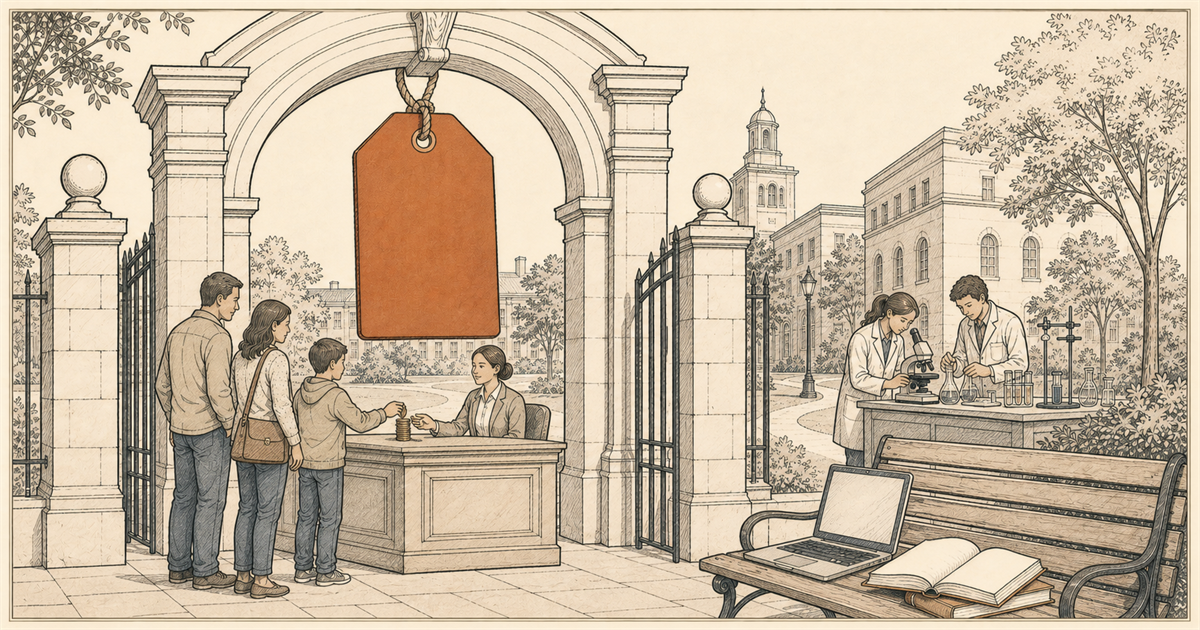
One camp looks at Harvey Mudd College’s $104,512 annual price and calls higher education America’s most overpriced product. The other says a strong university and a strong major may be the best investment a young person ever makes. Both claims can be true. They are pricing different things.
Start with the number. Harvey Mudd’s figure is its 2026–27 cost of attendance, not tuition alone. It includes housing, food, books, personal expenses, and an orientation fee. More important, it is a sticker price. At private nonprofit four-year colleges, 87 percent of first-time full-time students received grant aid in the latest detailed data. The estimated average net tuition and fees in 2025–26 were $16,910, not the $45,000 published average. At public four-year colleges, the comparable net figure was $2,300 for in-state students.
The sticker is real. It is just not a prediction.
The overpriced camp still has a serious case. Some families do pay full price. Living costs survive the scholarship. The largest economic cost may be four years of wages not earned. And the payoff is brutally uneven. The New York Fed estimated a 12.5 percent return for the median college graduate in 2024, but only 2.6 percent for graduates at the 25th percentile of earnings. A degree unfinished, stretched to six years, or attached to a weak labor market is a different investment from the average in the brochure.
The investment camp also has a serious case. A median return above 12 percent is hard to dismiss. The wage premium has survived tuition increases because employers still pay for the degree, the skills, or both. Universities also sell things a free video cannot: assessment, a recognized credential, deadlines, peers, laboratories, mentoring, and a recruiting market. Calling all of that “content” is like calling a gym a collection of exercise instructions. The instructions were never the scarce part.
This also explains the strange price history. In real terms, published tuition fell 7 percent at public four-year colleges over the decade to 2025–26 and rose only 2 percent at private nonprofits. The longer trend is much uglier, but the recent six-figure shock is partly inflation, living costs, and discount theater. A high sticker lets a college charge wealthy full-pay families more while handing other students an institutional grant. Add labor-intensive teaching, more student services, expensive facilities, and pressure on public funding, and there is no single villain to drag before Congress. Annoying, I know.
But price is only half the accusation. Even a heavily discounted university is expensive if its main product can now be learned for free. The internet already opened lectures, textbooks, and tutorials. AI adds a patient tutor that can explain, quiz, translate, and debug at almost no marginal cost. If a university is mainly a machine for delivering information, its problem is no longer merely the price. The product itself is becoming free.
That is where the two arguments meet. AI does not make the university pointless. It makes the information layer much harder to charge for. Explanations, practice questions, coding help, and course notes are becoming cheap. Verification, completion, access, and trusted credentials remain scarce.
Georgia Tech offers one glimpse of the bargain that may replace the old one. Its online computer-science master’s requires 30 credits and charged $225 per credit in 2025–26, plus semester fees. The diploma carries the same degree name as the residential program. The lectures travel cheaply; the university keeps admissions, assessment, support, and the credential.
So is college worth it? Not at “the average price,” because almost nobody is an average student buying an average degree. Ask for the net price, add the wages given up, then ask what scarce thing this particular program provides and how likely the student is to finish it. If the answer is merely information, AI and the internet have already won. If it is a credible path through hard work into a field that still rewards the credential, the old campus may remain expensive and still be cheap.
