Pay Per Tail
The moment you turn a number into a target, it stops telling you the truth.
That is a big claim, and it deserves a hard look before anyone hangs a policy on it. An economist named Charles Goodhart noticed the pattern in central banking in the 1970s. An anthropologist later sharpened it into one line: when a measure becomes a target, it stops being a good measure. Neat, quotable, and possibly too neat. So let me try to break it.
The first objection is obvious. Targets work. You cannot run anything without them. Tell a factory to cut defects and defects fall. Tell a team to ship by Friday and it ships. Half of management is picking a number and pointing people at it. If aiming at a metric always corrupted it, no organization on earth would function, and plenty do. What gets measured gets managed, and usually that is a good thing.
That objection is right often enough that the bald claim needs trimming. The metric doesn’t rot when it is the thing you care about. Count defects, and fewer defects is the actual goal; the number and the aim point the same way. The rot sets in when the number is a stand-in for something bigger and messier, and when people can move the number without moving the thing it was standing in for. Then you have handed them two ways to hit the target, the honest way and the cheap way, and pressure decides which one they take.
Watch it happen in a school. Nobody can measure “an educated child,” so we measure the test score, which is meant to track it. Attach enough weight to the score, and teachers start teaching the test. Scores climb. The kids get better at that exam and not necessarily at anything else. The measure rose and the goal didn’t move, which is the failure the rule predicts, dressed up as success.
Same shape in a hospital. Set a rule that patients must be seen within four hours of arriving at the emergency room, a sensible proxy for “treated promptly,” and you get faster care in a lot of places. You also get, in some, patients held in ambulances outside the door so the clock doesn’t start, and admissions timed to the last safe minute. The four-hour number looks wonderful. Some of it is real. Some of it is the clock being managed instead of the patient.
Then there is the version with a fraud trial at the end. A bank decided the way to grow was to sell each customer more products, and it made that a target with teeth: hit your cross-selling quota or lose your job. Employees hit it. To hit it, they opened millions of accounts and cards their customers never asked for and didn’t know about. The metric the executives wanted, accounts per customer, went straight up. The thing it was supposed to represent, customers choosing to do more business, was replaced by an invention. The measure was met and the reality behind it was faked wholesale.
Notice that in each case the people gaming the target were not cartoon villains. They were teachers who wanted to keep their jobs, nurses under an impossible clock, clerks with a quota they couldn’t make honestly. That is the strongest form of the claim. You do not need bad people for a target to corrupt its own measure. You only need ordinary people and enough pressure. The incentive does the work.
Which brings me to the exhibit I’ve been holding back, because it is the purest version of the whole business and it happened long before anyone wrote the rule down.
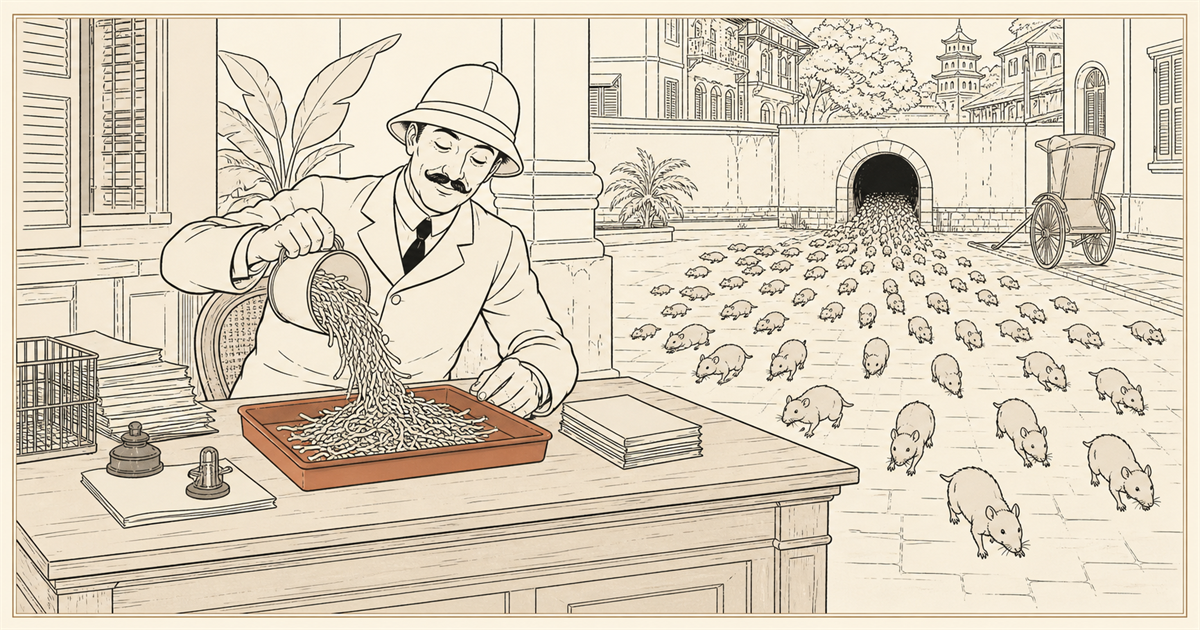
Hanoi, 1902. The French colonial administration had a rat problem in the new sewers and decided to pay its way out. A bounty: bring in a dead rat, collect a small reward. To spare the clerks a mountain of corpses, they accepted a rat’s tail as proof. Hand over a tail, get paid.
The tails came in by the thousands. The rats did not go away.
Out in the city, officials began noticing rats running around with no tails. People had worked out the trick the bounty was really rewarding. You didn’t need a dead rat. You needed a tail. So catchers snipped the tails off live rats and let them go, because a live rat breeds more rats, and more rats means more tails, means more money. Some enterprising residents started farming the things. The policy meant to shrink the rat population had paid people to grow it.
The administrators wanted fewer rats. They measured tails. They got exactly what they paid for, and none of what they wanted.
So the rule holds, in its trimmed form, and it is worth carrying into any room where someone proposes to fix a hard thing by rewarding an easy number that stands for it. Ask one question before you sign off. Can this target be hit without doing the real thing it is supposed to represent? If the answer is yes, someone under pressure will find that door, and you will get a city full of tailless rats and a report saying the hunt is going beautifully.
