Enough of This Nonsense
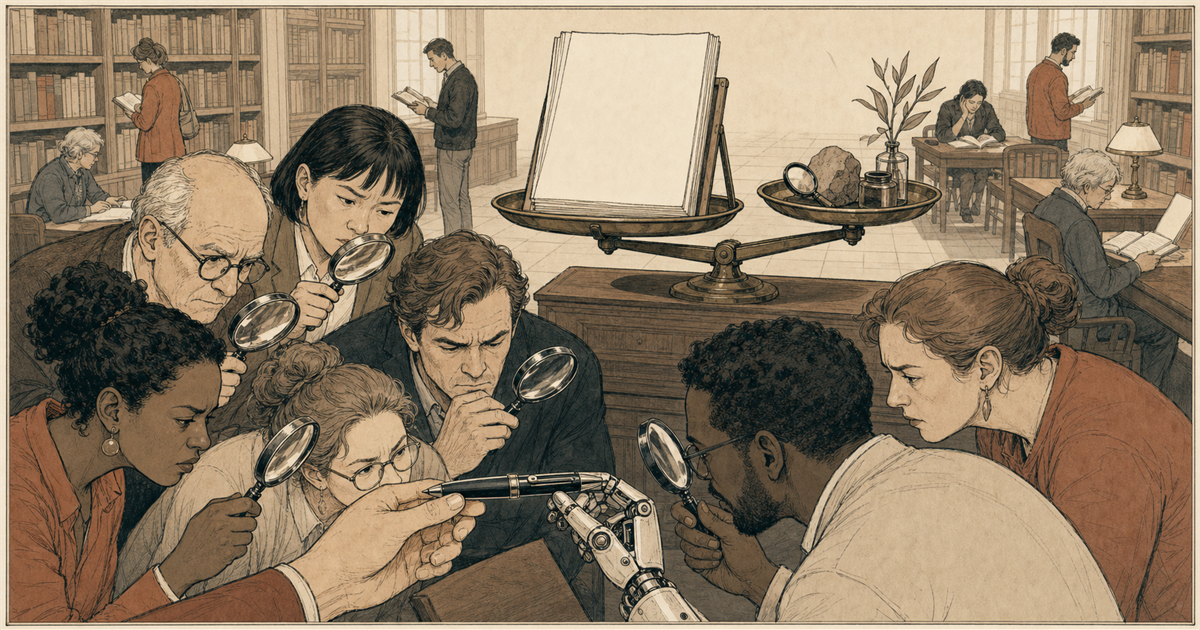
Stanley Druckenmiller used AI to help write an op-ed.
The republic survived the night, but only just.
His Wall Street Journal piece attacked the Treasury’s decision to double long-dated bond buybacks. Druckenmiller called it price management dressed up as liquidity support. Within hours, however, the argument had become secondary. X had found a more exciting scandal: the sentences looked like AI.
Ooooooh. Aaaaaah. Civilization ends at noon.
The ritual is now familiar. A new article appears. A few comments later, the first AI hunter arrives. Amateurs wrinkle their noses and ask why the author had to use a machine. Professionals paste the text into a detector, post the red screenshot and announce the verdict: 100% AI.
Then everybody discusses the production method. Almost nobody discusses the product.
Was Druckenmiller right about the bond market? Were his numbers right? Did the Treasury intervene in a healthy market, or was the buyback a sensible piece of market maintenance? Was the article worth three minutes of attention?
Apparently these are old-fashioned questions.
Druckenmiller did not deny using AI. “Of course I used AI,” he told NOTUS. “There’s a reason I moved from an English major to being an economics major.” He added that he now uses AI for everything he writes, for the same reason he uses a calculator for math. The message, he said, was his.
Good.
The name on an opinion piece should mean one thing: the named person owns the argument. Every claim, every number and every mistake belongs to him. If the view is borrowed, the facts are invented or the author cannot defend the piece, that is a failure. It remains a failure if the prose was written with a fountain pen under candlelight.
If the argument is genuinely Druckenmiller’s and he used a machine to express it better, I struggle to locate the scandal. We do not demand disclosure of spellcheck, tracked changes, a research assistant, a patient spouse or an editor who removed six pages of throat-clearing. We judge the finished work. Or at least we used to.
The gatekeepers have another complaint. If Druckenmiller did not spend hours forming his own sentences, perhaps he did not put enough work into the article.
This confuses effort with value.
Druckenmiller’s fifteen minutes may be worth more than another person’s three days. Painful, yes. Also true. The quality of a piece is not determined by the time spent typing it. It is determined far more by what the author spent decades doing before he sat down: what he learned, what he noticed, what he got wrong and whether he has an idea worth stealing fifteen minutes to express.
A calculator does not make you Stanley Druckenmiller. Neither does Claude.
Then we have the Pangram certificates. Pangram may be a very good classifier. Its latest technical report claims a false-positive rate of 0.0041% on more than a million human texts. That is impressive. It is still not a forensic camera pointed at the writing process. A “100% AI” result means the detector classified every text window as AI-generated. It does not mean Pangram watched every word being born, knows who supplied the argument or can divide intellectual ownership to the nearest percentage point.
I know the practical absurdity from my own work. Take an original article, run it through a model only to translate it, and the detector may return 100% AI. What has it measured then? The provenance of the ideas, or the statistical surface of the final English?
That distinction matters. A detector can identify patterns without answering the question readers pretend they asked. The screenshot may be evidence of AI assistance. It is not a review.
There is a respectable objection underneath the theatre. AI can invent facts, flatten voice and turn a sharp idea into beige office prose. An expert can also outsource the thinking, approve rubbish and hide behind a famous name. In finance, where a prominent investor’s words may move money, the author must mean what the article says.
But all of those failures are visible in the output. Check the facts. Test the logic. Compare the claim with the author’s actions. Ask whether the piece contains judgment that could only come from someone who has done the work. If it fails, tear it apart.
Just tear apart the article, not the keyboard.
And to the readers who stop after three sentences because they can “feel the AI”: I would like to see the blind-test score. Human intuition is marvellous after the answer has been posted underneath. Remove the label and confidence often becomes performance art.
Humans can write well or badly. Machines can write well or badly. The inconvenient difference is that the machines will be better a few months from now than they are today. It is only a matter of time before they write better than the average commenter hunting them.
Or perhaps that sentence requires the past tense.
More respect for machines would be nice. More respect for articles would be better. Read them. Judge them. Reject them for being false, dull or empty. Do not reject them because the author used the most capable writing tool available.
This essay was generated by AI.
Please try to judge it anyway.
