The Instrument That Breathes
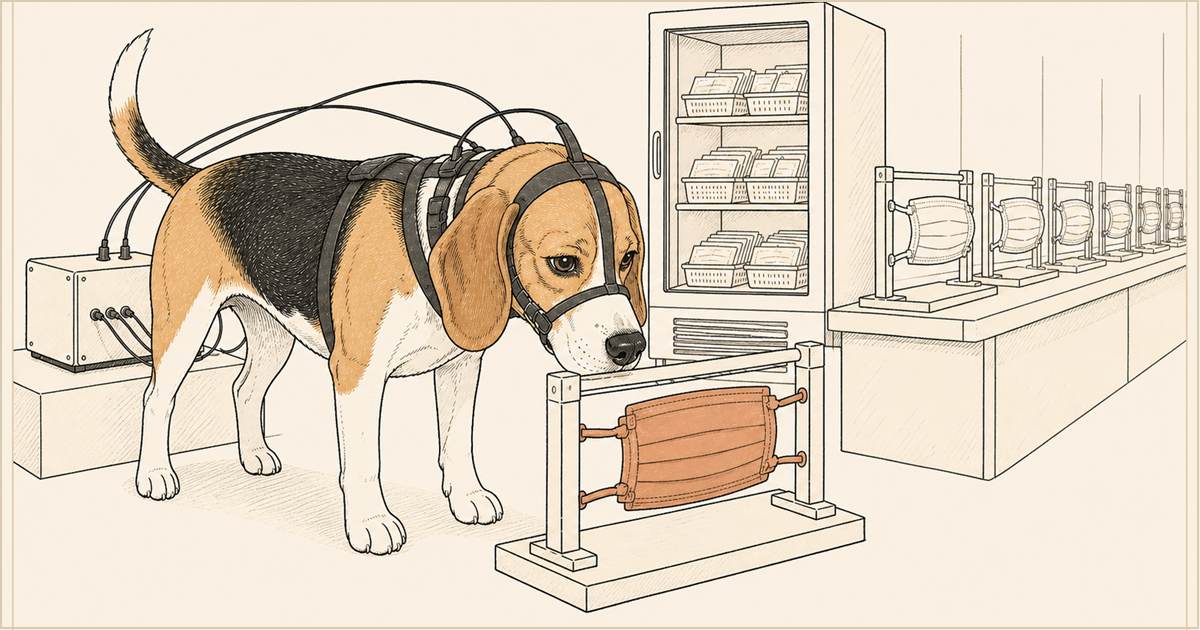
The dog is not the weak part of this cancer test. The screening math is.
I know that sounds wrong. A dog gets tired. It wants food. Its performance can change with the handler, the training, the room, and whatever happened five minutes ago. No regulator dreams of approving a medical test whose key part may stop cooperating because a squirrel passed the window.
Yet the nose works.
In a recent study across several Indian hospitals, trained dogs examined breath collected on cotton masks. The test group included 1,502 people, and 283 had cancer confirmed by biopsy. A model combined the dogs’ signals, giving more weight to dogs with better records and using information about each participant. The system found 90.8% of cancers and correctly cleared 91.3% of non-cancers. It worked about as well on early-stage disease.
Those numbers deserve attention. But they came from a study designed to prove that the signal exists. Nearly one person in five in the test group had cancer. A normal screening population looks very different.
Imagine the same test in a group where one person in 100 has cancer. Screen 1,000 people. It would find about nine of the ten cancers. It would also flag about 86 people who were cancer-free.
About nine out of ten positive results would be false alarms.
That does not kill the idea. It tells us what the product can be. This is not a diagnosis. It is a first gate that sends a smaller group toward scans, blood tests, or biopsy. Its value depends on what happens after the dog says yes. How expensive is the next test? How much worry and unnecessary treatment can the system create? Which group has enough cancer risk for the numbers to improve?
The equipment around the nose matters for the same reason. In the published study, breath masks were kept in a minus 20 degree Celsius cold chain, and several dogs read each sample. Software combined their answers. The company is also building headsets and harnesses that record brain activity, breathing, movement, and facial cues so machine learning can read the dog more consistently.
But I would keep one line bright red. Those sensors did not produce the published Phase II result. That paper tested dogs plus a statistical model. The brain-computer interface is the next claim, and it still needs its own proof.
“AI reads a dog’s mind” makes a better pitch than “three dogs, a freezer, mask delivery, calibration, and a path to confirm the result.” I get why the first version travels. The second one is the actual business.
This is the part I find hard to shake. We tend to picture engineering progress as replacing biology with a clean device. Here the sensible route may be to keep the living sensor because it notices a chemical pattern we still cannot fully name. Then we build enough controls around it to make the answer usable.
The limits do not disappear. Dogs need training, housing, rest, care, and repeated checks. Samples have to survive collection and transport. Food, drugs, smoking, inflammation, and other diseases can change the chemicals in breath. A model can make the dog’s response easier to read. It cannot fix a bad sample.
Could this scale? Maybe. A central site can test masks without putting dogs in hospitals, and more scent stations can raise capacity. But you cannot add biological sensors by ordering another box of identical chips. Capacity grows slowly. Quality control has a pulse.
Electronic noses may catch up. A review of 52 cancer studies found encouraging overall accuracy, though most studies were small and poorly standardized. So this is not a contest between miracle dogs and hopeless machines. It is a contest between two unfinished systems. One is easier to manufacture. The other can smell.
In 1989, two doctors wrote to The Lancet about a woman whose dog would not leave a lesion on her leg alone. She sought medical help. The lesion was a melanoma.
