The Day the Clerks Disappeared
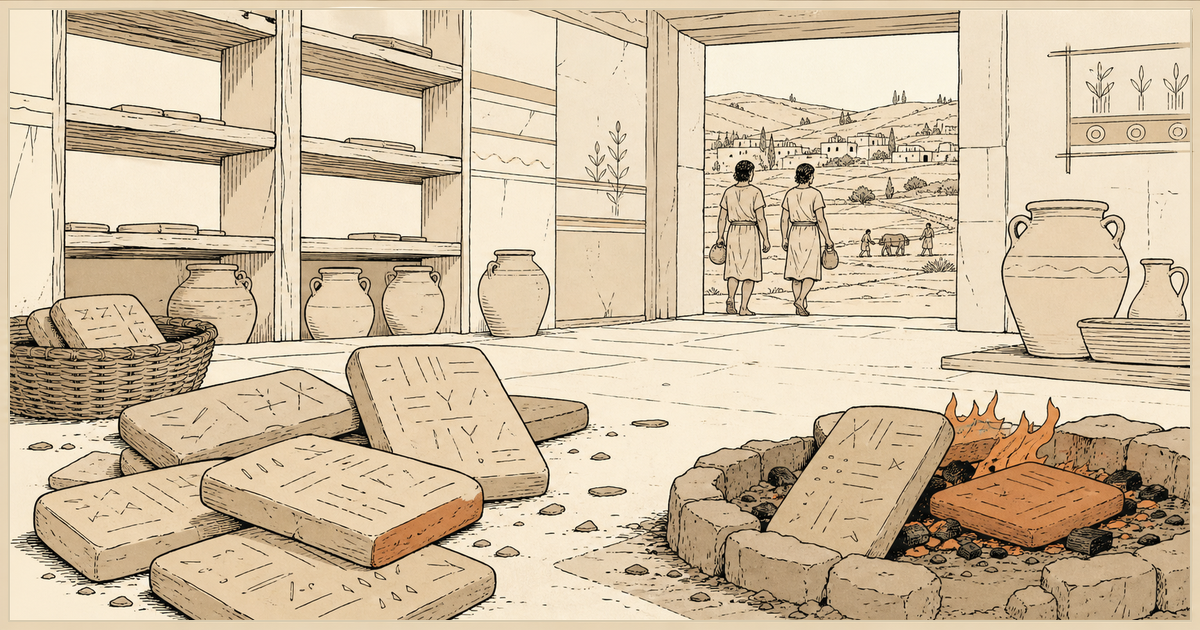
Around 1200 BC, the palaces of Mycenaean Greece burned. The fires destroyed the administrative system and accidentally preserved its paperwork: clay tablets, baked hard by the heat, listing grain, wool, land, workers and offerings in a script we call Linear B.
Then the writing stopped.
The people did not vanish. Greek was still spoken. Farms, families and local communities continued. But the narrow class of palace scribes and the institutions that used their records disappeared. For centuries, Greece had no writing system we can see. The clerks were gone, and with them went a particular ability to count, coordinate and remember across a large territory.
That is a better image of civilizational collapse than the usual fireball. Collapse is not everyone dying on Tuesday. It is Wednesday arriving and nobody knowing how to run the system that existed on Monday.
Sarah Wilson’s new book, I Eat the Stars, places climate change, inequality, political polarisation, falling fertility, resource pressure and war inside one story: a complex civilisation beginning to buckle under its own extensions. The argument belongs to a long tradition. Archaeologist Joseph Tainter gave collapse its most useful working definition: a rapid, significant loss of an established level of social and political complexity.
Useful, but incomplete. Complexity can be expensive, absurd and oppressive. Removing twelve approval forms is simplification; so is losing the office that keeps land records. One is reform. The other may end with three armed cousins arguing over the same field.
The important question is not how much complexity disappears. It is whether a society can choose what to simplify while preserving the knowledge and coordination needed to choose again.
Call this option-preserving capacity. It lives in dull places: archives, schools, courts, maintenance teams, professional norms, tax records, spare parts, shared measurements and people who know whom to telephone. A civilisation is transforming when it can deliberately retire an institution, move its useful knowledge and build a replacement. It is collapsing when institutions fail faster than their functions can be named, transferred or rebuilt.
This test also explains why historical labels are political. Archaeologists can speak of the collapse of particular Classic Maya states while also stressing that Maya societies changed, moved and continued. The cities of one region may empty while communities elsewhere adapt. Collapse for a palace is not disappearance for a people.
History is rude enough to permit both stories at once.
The story we choose still matters. A collapse narrative can force neglected risks into view. It can puncture the comfortable belief that every shortage is temporary and every broken service will be restored by a slightly better app. But doom also shortens the political horizon. If the end is fixed, then cooperation looks naive, maintenance looks pointless and the rational citizen buys a generator, a fence and perhaps a podcast about crossbows. Elites discover that emergency powers are easier to sell than patient repair.
The transformation story has the opposite defect. It keeps agency alive, which is valuable, but can turn suffering into a PowerPoint arrow. A town closes, a job vanishes, a language weakens, and someone at a conference calls it transition. The word may be accurate from thirty thousand feet. The people below still hit the ground.
So neither optimism nor pessimism is a diagnosis. Look instead for the machinery of choice. Can governments still collect reliable information? Can they move resources without routine corruption or violence? Can experts train successors? Can rival groups accept a common measure long enough to repair a grid, share water or run an election? Can a community simplify one system without losing three others tied to it?
These are less dramatic indicators than fertility charts or billionaires building bunkers. They are also closer to what collapse has meant in practice. Societies survive enormous falls in wealth, changes of regime and movements of population. What they struggle to survive is the loss of the connective tissue that turns scattered skill into collective action.
I have no idea whether our civilisation is collapsing. Anyone offering a date is selling the intellectual version of canned beans. We plainly face overlapping stresses, and some institutions are already failing particular people. We also retain astonishing stores of knowledge, global communication and the ability, at least sometimes, to coordinate at a scale Mycenaean administrators could not imagine.
The future may demand a simpler civilisation. Simpler energy systems, shorter supply chains, fewer layers of bureaucracy or more local authority might be sensible. The aim should not be to preserve every existing institution in amber. It should be to simplify without burning the tablets.
The opposite of collapse is not endless growth. It is keeping enough shared memory and trust to decide what comes next, after the palace is gone.
