A Courtroom Is a Bad Laboratory
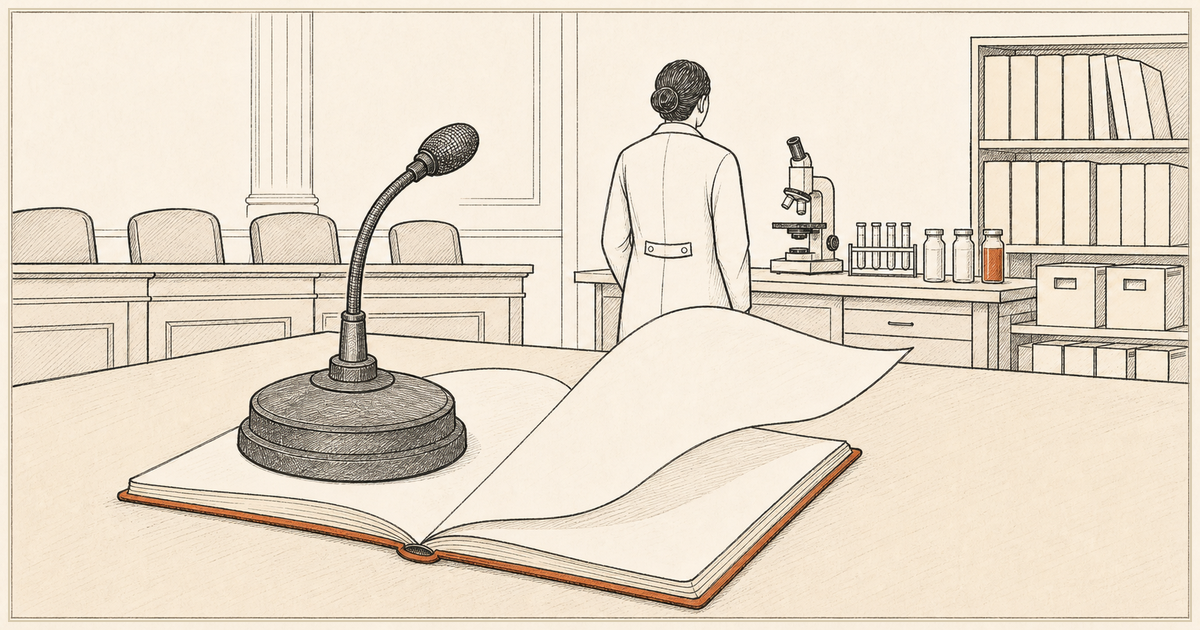
Anthony Fauci sat before a US Senate committee on 29 July and gave the same short answer more than a hundred times. Following his lawyer’s advice, he invoked the Fifth Amendment and refused to answer.
The hearing was about the origins of Covid, government-funded research and Fauci’s earlier statements to Congress. Senators wanted accountability. Fauci’s lawyers saw a fresh sworn statement that could support a later perjury case. Both sides made a rational choice. The result was three hours in which the country’s most famous public scientist said almost nothing.
His silence proves neither guilt nor innocence. It shows something less satisfying and more useful: a courtroom and a laboratory are machines built to find different kinds of truth.
A courtroom asks whether someone crossed a legal line. It freezes words, compares statements and assigns blame. Science asks what the evidence supported at the time, how strongly it supported it, and what new fact should change the answer. One system needs a fixed record. The other needs a record that can move.
Put both systems behind one microphone and movement starts to look like contradiction. Contradiction starts to look like deceit. Soon the safest scientific sentence is one that can never be checked against anything later.
Silence.
Scientists do not deserve a priestly escape hatch. Public money gives the public a right to inspect methods, contracts, conflicts, emails, data, code and decision records. Making up data, hiding evidence and knowingly lying to Congress are not harmless parts of uncertainty. They are misconduct. The US Office of Research Integrity states the line clearly: honest error and differences of opinion are not research misconduct.
That sounds obvious until politics gets angry. Then three different failures become one. A hypothesis can fail even when the work was sound. A researcher can be careless without inventing data. An official can deceive Congress. If one punishment system covers all three, we do not get cleaner science. We get better lawyers and worse records.
Accountability works better when it looks at the process before the outcome. What did you know? What did you reveal? Which other explanations did you test? Did you call exploratory work exploratory? Did you keep the data? Did you write down what would change your mind? Did you update the public record when the evidence changed?
Those are hard questions. Better still, they can be answered without treating a negative result as a crime.
Some scientific institutions already use a smart device called a Registered Report. Researchers submit the question and method before they know the result. Reviewers judge the plan first, and publication is not cancelled just because the result is boring or awkward. Accountability moves earlier: did you do what you promised? The result becomes information, not a judgment of character.
Public science needs the same design. Important claims should have version histories. Advice should state the confidence level, the evidence available on that date and what would cause an update. Data and analysis should be open whenever privacy and security allow. Corrections should remain visible, linked to the original claim, and protected from being used alone as proof of wrongdoing.
Protection must not mean immunity. A safe path for correction should cover quick, recorded updates, not sudden memory loss after the documents appear. Whistleblowers need protection as well. The question is not simply whether an institution changed its story. The question is whether the trail shows honest learning or planned concealment.
We should also separate scientific advice from political choice. A scientist can estimate how likely a virus is to spread or how uncertain an origin theory remains. Closing schools, funding a lab or limiting travel adds values, costs and trade-offs. Politicians cannot hand those choices to a white coat and then bring the coat back years later as the only owner of the decision.
I think we need two rooms. Use the adversarial room to investigate misconduct: documents, witnesses, intent, fair procedure, consequences. Use a permanent evidence room to rebuild what was known, compare rival explanations and publish a living account that can change without legal theatre. Let the rooms share records, but do not give them the same job.
Perhaps Fauci had answers that would have helped the public. Perhaps those answers would have harmed him. I do not know. The hearing showed that when every scientific update might become the next exhibit, we create a perfect reason for experts to sound certain at the start and remember nothing at the end.
That is accountability theatre. The public deserves something harder: a system where lying is dangerous and changing your mind is safe.
