The State That Never Stands Down
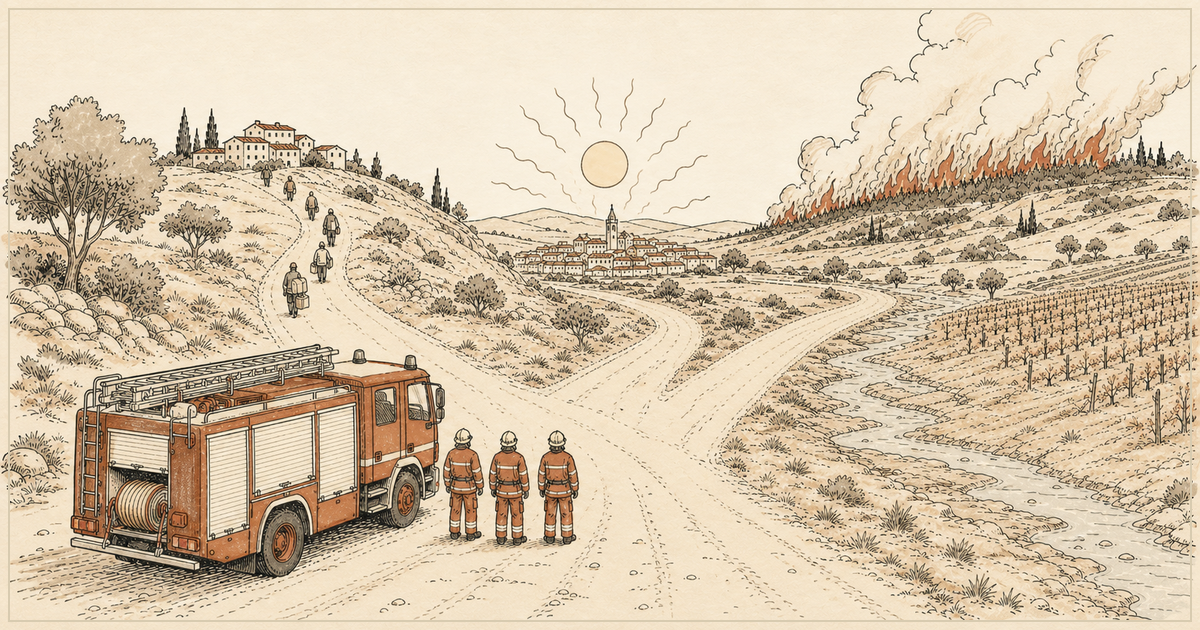
On 29 July, three firefighters died in Greece while an uncontrolled blaze in south-west France threatened an area four times the size of Paris. France, Spain, Greece and Italy were all fighting major fires at once. Heat had dried the plants; drought had made thicker wood burn; wind did the rest.
Europe had prepared. This summer the EU put together its largest wildfire operation yet: 777 firefighters stationed in high-risk countries, backed by 22 planes and five helicopters. Then the fires arrived together, which is how a record reserve starts to look small.
This is the part of climate adaptation that rarely fits on a campaign poster. A fire engine can beat a fire. It cannot beat many fires everywhere.
The same week, England’s official drought report said 84% of monitored river flows were below normal or worse, reservoir storage was 7.4 percentage points below its seasonal average, and almost 40% of the population faced water restrictions. This was not a movie version of collapse. Taps mostly worked. Roads were open. The state was simply dividing scarce water while several other public systems dealt with heat at the same time.
That is the new problem. Emergency government was built around a break: mobilise, rescue, repair, return to normal. When the danger becomes the background, the last step stops making sense. You cannot return to a climate that has left.
The obvious answer is more capacity. More aircraft, reservoirs, cooling centres, backup generators, fire crews and hospital beds. Much of that is needed. Europe is the fastest-warming continent, heating at more than twice the global average, and pretending yesterday’s staffing will handle tomorrow’s extremes is spreadsheet comedy.
But capacity is not the deepest shortage. What we really lack is permission to stop defending everything.
Every government prefers adaptation that leaves the map alone: a higher wall, a wider firebreak, a larger pipe. It spends money, creates jobs and lets a minister stand beside new concrete. Retreat does the opposite. It admits that a road, neighbourhood, forest use or kind of farming may no longer deserve an unlimited public promise. The ribbon-cutting ceremony for a place you plan to leave is, understandably, not popular.
So we delay until the market makes the choice badly. Insurers pull out. Property prices fall. Richer families leave first. The town loses tax income just when protection costs more. Poorer residents inherit both the danger and the smaller budget.
Retreat happens anyway. It is simply private, late and cruel.
A state built for permanent extremes must make these choices before the flames. Risk maps must change with the risk, not once a decade. Public budgets need permanent adaptation money instead of heroic emergency bills. Wildfire policy must include year-round care of the land, not just ever braver firefighting. Hospitals, schools and water systems in places at the edge may need movable, smaller or deliberately reduced service rather than another building meant to last fifty years.
Most of all, governments need public trigger points. After how many serious floods does a buyout become automatic? At what fire risk does new construction stop? When does a road move from full repair to seasonal access? Which protections are promised, for how long, and who pays for the move?
These lines will never be morally neat. A home is not a box in a spreadsheet; a village can hold language, graves, work and memory. Fair retreat therefore needs somewhere to go: housing, transport, jobs, schools and a say in what comes along. A cheque without a receiving town is not adaptation. It is an eviction on nicer paper.
There is a danger to freedom here too. A permanent emergency can become a permanent excuse for executive power. The answer is not to keep calling every summer exceptional. Put the choices into ordinary law: open maps, agreed thresholds, rights of appeal, compensation rules and budgets voters can see.
The three firefighters in Greece died doing what the old model asks: stand between a community and the exceptional event. We honour that work with more than praise and a bigger fleet. We honour it by refusing to send rescuers, year after year, to defend political choices nobody was brave enough to make in daylight.
