The Price of a Common Language
At last summer’s World Esperanto Congress in Brno, a Chinese priest stood in an old Czech chapel and celebrated Mass in a language invented by a Polish Jewish eye doctor. The day honoured Titus Brandsma, a Dutch friar murdered at Dachau. The congregation replied in Esperanto. Nobody in the room owned the language. Everyone had paid the same entry price: learning enough to take part.
That little scene tells us more about Esperanto than the usual joke about how it failed.
Ludwik Zamenhof published the language in 1887 after growing up in multilingual Białystok, where different communities lived side by side without much trust. His idea was simple and wonderfully bold. Give people a neutral second language, easy enough for anyone to learn, and clearer talk might weaken the hatred carried by nations and tribes.
It did not work on the scale he hoped. The world did not sign up. English spread instead, pushed by history and power rather than neat grammar. Esperanto survived as a small, stubborn world of congresses, books, hosts, hobbyists, peace campaigners and, yes, nudists taking a tram to the beach.
Then the machine turned up.
Google says its services now translate about one trillion words a month. Its app can handle live conversations in more than 70 languages, and the wider service supports almost 250. What once took years to learn can increasingly be borrowed by the second. In practical terms, machine translation has beaten Esperanto so badly that someone should blow the whistle.
For ordering food, reading instructions, helping a patient or letting a refugee fill in a form, this is simply good. You should not have to pass a language exam before you get safety, work or basic dignity. Better translation can also let people keep speaking a small native language instead of giving in to English.
Access matters. It is just not all that unity means.
Esperanto asked something odd of its users: everyone had to step away from home. A French speaker could not insist on French; a Russian could not stay inside Russian. Both sounded clumsy. Both made mistakes. Both spent time on a project with no clear financial reward.
Maybe that inconvenience was the product.
Researchers call this a costly signal. A promise looks more real when making it costs you something. Learning a shared language does not prove that you are kind, peaceful or even good company. It does show that you were willing to look silly for a while before asking a stranger to meet you. That effort cannot guarantee trust, but it gives trust something to grow from.
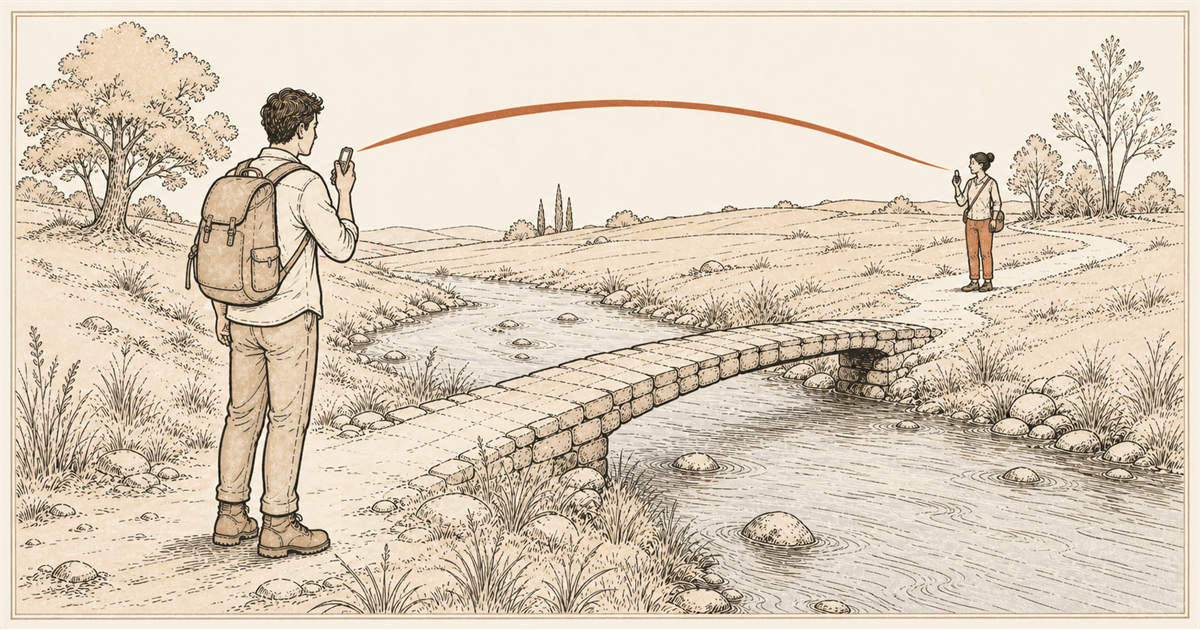
Machine translation removes the price. That is both its magic and its limit. I can stay safely inside my own language, hear you in mine and leave the furniture in my head untouched. The words make the trip; you and I do not have to.
So a perfect translator could give us a strange world: everyone has access, but there is no common room. Billions of private channels work perfectly, while nothing shared grows between them. We understand every sentence and still make no gesture together.
I am not suggesting that we throw away the machine. We do not have to choose. Use translation to open the door. Learn another language when you want to walk into the house. Sometimes speed is the decent answer; sometimes spending your time is how you tell another person, you are worth the trouble.
Software could have put every line of that Mass in Brno into each listener’s native language. It would have been quicker, tidier and probably more accurate. But the congregation would no longer have been doing one small, hard thing together. Each person would have been receiving a private service.
The message would cross.
Nobody would cross the bridge.
