Whose Finish Line?
Twenty-two lottery winners. Twenty-two people who won nothing. Twenty-nine who had been paralyzed in accidents.
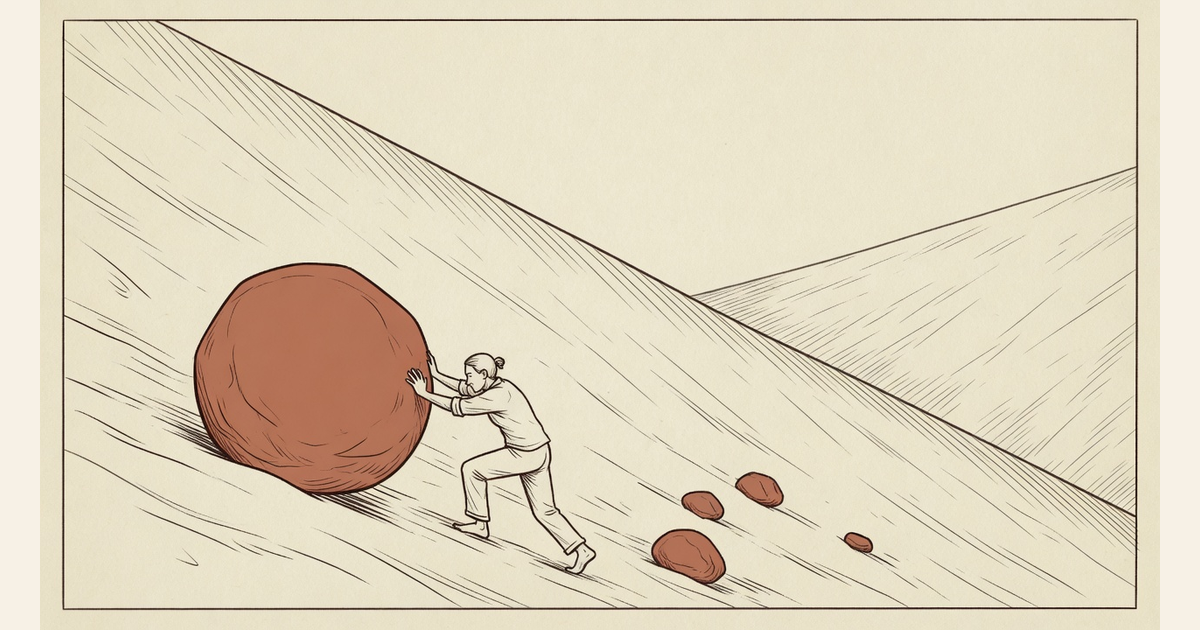
In 1978 three psychologists lined up those groups and asked a blunt question: are the winners happier? They weren’t. Within a year the winners rated the small pleasures of ordinary life — a good meal, morning coffee, a chat with a friend — lower than the people who never won a cent. The money hadn’t raised their floor. It raised their ceiling, and everything under it now looked cheap by comparison. That study gave us the phrase “hedonic treadmill,” and I think it should be the first thing they hand you at the door of the self-help aisle.
They don’t. The whole aisle is built on the opposite idea: that success is a place, it has a formula, and the formula is for sale.
Before you ask how to get there, ask whether “there” is a real spot on the map.
Take the most repeated line in the genre — money doesn’t buy happiness. It sounds wise. Mostly it’s used to help comfortable people feel deep, and I’ve caught myself doing exactly that. It’s also too easy. For years the go-to number was Kahneman and Deaton’s: day-to-day happiness rose with income and then went flat around $75,000. Sermon written. Then Matthew Killingsworth ran his own numbers and found no flattening at all — happiness just kept going up. Two serious researchers, opposite answers.
So in 2023 they did the thing almost nobody does. They sat down together, brought in a referee, and worked it out in one paper. The answer wasn’t a neat middle. For most people, happiness does keep rising with income, well past a hundred grand. But there’s an unhappy group for whom money stops helping once the basics are covered — for them, and only them, the old flat line is real. “Money can’t buy happiness” was never a law. It was one group of people mistaken for everybody.
See what just happened? We took a claim everyone treats as settled and found the real answer underneath was it depends on who you are. Hold onto that, because it’s the whole point.
Now the harder problem, and it isn’t about feelings. It’s about counting. A lot of what we call success is made of what the economist Fred Hirsch called positional goods — things that are only worth something because they’re scarce. The corner office. The school that takes one kid in twenty. The street everybody wants to live on. You can’t make more “top of the class.” Build it that way and most people, by the rules of the thing, don’t get it. So when success means beating other people to a scarce spot — and a shocking amount of it does — a world where everyone succeeds isn’t heaven. It’s a square circle. Someone has to be the person you beat.
So even if I handed you a perfect happiness meter, “everyone is successful” would still be impossible, the same way “everyone finishes in the top ten” is impossible. Not hard. Impossible.
Then geography breaks the meter for good. The psychologists Hazel Markus and Shinobu Kitayama showed long ago that the self isn’t wired the same everywhere. In one place you’re your own unit, and the job is to stand out. In another you’re a knot in a net, and the job is to fit. Ask each what a good life looks like and the answers don’t just differ — they flip. The Japanese idea of ikigai puts a life’s worth in daily purpose and quiet usefulness to others. The American self-made story treats the very ties ikigai is built on — needing people, owing people, belonging to people — as weight slowing you down. There’s no exchange rate between the two. One culture’s win is another culture’s showing off.
Here’s a question the gurus never sit with. If the target changes shape depending on where you were born, what are they actually teaching you to hit?
And why do we grab at the target so hard to begin with? One of the strangest findings in the whole field points at death. Terror Management Theory — three psychologists, 1986 — says that when we’re quietly reminded we’re going to die, we reach harder for whatever our culture happens to prize: money, status, fame, a name that lasts. Success, read this way, is partly a blanket we pull over the fact that we don’t get to stay. That doesn’t make wanting things fake. But it does mean that how hard I’m chasing something isn’t proof I’ve picked the right thing. Sometimes it’s just fear in a nice suit.
Which brings me to the part the whole business is built to dodge.
A philosopher named W. B. Gallie, back in 1956, had a label for words like this: essentially contested concepts. Justice. Art. Freedom. Words whose correct use is a fight that never ends. The argument isn’t a fault you fix with a sharper definition — the argument is the word. “Success” belongs on that list, and once you put it there, hunting for the one true meaning stops looking like deep thinking and starts looking like a mistake about what kind of word it is. You’re demanding one answer from a word built to spit out many.
Thomas Nagel put the point even harder. To define success from the outside, neutrally, you’d have to step out of every particular life and look from nowhere. But success only means anything to somebody, from inside their own life. Climb high enough to see it from above and you’ve climbed out of the only place it lives. The view-from-nowhere definition deletes the very person it was for.
So is that where it ends — success is “personal,” shrug, buy the mug?
No, and I want to be careful here, because that’s the lazy exit. “It’s all personal” is a quiet way of saying the question doesn’t matter. It matters a lot. It’s just not the question you were handed. Amartya Sen spent his life arguing we measure people at the wrong layer — not by what they own but by what they’re actually able to be and do, given who and where they are. The philosopher Charles Taylor called the real work sorting out which things are genuinely worth wanting in the first place. That’s not softer than a formula. It’s much harder. A formula you can follow half-asleep. Figuring out what would truly count, for the one life you’ve got, takes being awake.
And there’s one last trap, and it’s almost funny. We’re terrible at guessing our own future selves. Psychologists call it the end-of-history illusion: at every age, people admit they’ve changed a lot and swear they’re now basically finished changing. They never are. So whatever meaning of success I set in concrete this year, my future self will quietly find small — the same way I now wince at what I was so sure about at twenty.
Which means the real answer to “how do I become successful” isn’t a method. It’s a smaller question, asked honestly.
Not where’s the finish line — there’s no shared one, and yours will move.
The question is what you’d want to say you spent your days on, if you were someone who one day had to answer for them. And you are. So — what’s the sentence?
