The Rational Gambler
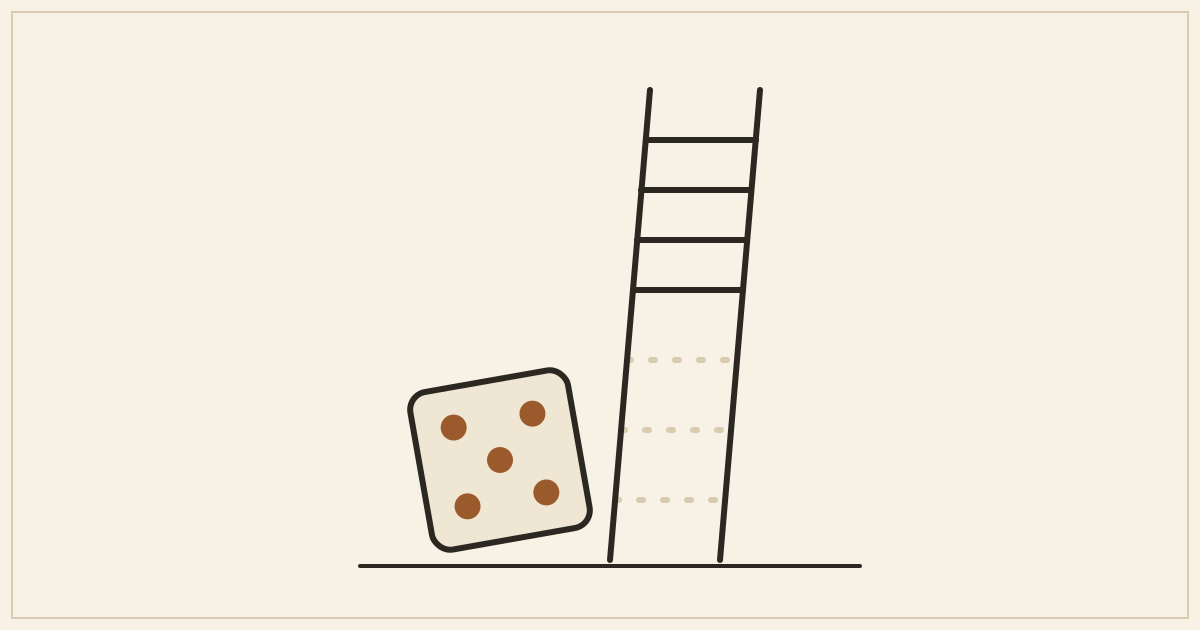
A 26-year-old puts his savings into leveraged bets on a handful of tech names. Reckless, says everyone older. Run the numbers from where he is standing, though, and he may be the only one in the room still doing the math.
Start with the arithmetic he grew up inside. In 1980 the median American home cost about three times median household income. By 2024 it cost more than five: prices up roughly 550% since 1980 against income growth of under 400%. The Federal Reserve’s own accounts show the bottom half of households holding a smaller share of the nation’s wealth than they did in 1989. “Slow and steady” was calibrated for a ladder whose lower rungs have since been sawn off. Compound interest is a wonderful thing, but four percent a year on a deposit that never reaches a down payment just buys a slower route to the same rented room.
So he does what the textbook quietly predicts he will.
Prospect theory, Kahneman and Tversky, forty years old and still underrated, says something specific and easy to miss. People below their reference point don’t get cautious. They get bold. Put someone far enough behind where they expected to be, and risk stops looking like danger and starts looking like the only door. The kid isn’t ignoring the odds. He has decided that the safe outcome, a lifetime of not-quite-enough, is itself a loss he refuses to lock in.
Now, is any of that new?
Here is the part the “it’s just another mania” crowd tends to skip. Every bubble we reach for as a warning, the 1920s margin frenzy, the dot-com day-traders of 1999, inflated during years of rising wages and widening opportunity. People gambled because things were good and getting better. Today’s version runs on the opposite fuel: four decades of flat real wages for the typical worker. Reaching for “irrational exuberance” to describe it may be pulling the wrong century’s label off the shelf. Exuberance implies you think tomorrow will be richer. This looks more like people who have concluded it won’t.
Watch what the money actually does. The pattern isn’t pure recklessness; it’s a barbell. Crypto and startup lottery tickets on one end, cash on the other, almost nothing in the sensible middle the advisers recommend. That is not someone who loves risk. That is someone who no longer trusts anyone to tell him which of the middle options is real. And why would he? In 2008 the assets stamped “AAA, safe” were the ones that detonated, while the institutions that built them got rescued. The gatekeepers preaching patience have a credibility problem they earned honestly.
Which is where I have to argue against my own sympathy.
Because the fact that each bet is understandable does not make the crowd of them wise. The visible winners get screenshots; the far larger pile of quiet losses gets nothing. The research is brutally consistent: the classic Barber and Odean work found individual traders reliably underperforming the index they could simply have bought, undone by their own overconfidence. That confetti animation when you trade is not there to help you compound. It is there to make you trade again. And the reliable winner across the whole casino is not the clever 26-year-old; it is the market maker taking a sliver off every frantic click. A rational response to a rigged ladder can still pour straight into a machine designed to skim it.
Both things are true at once, and that is the uncomfortable resolution. The ladder is genuinely broken, and that part is not a feeling; it is in the price-to-income charts. The response to a broken ladder can still be the fuel of the next crash, with the youngest and latest in line eating the loss, as they always do. A bet can be reasonable and unsafe in the same breath.
How it ends I won’t pretend to know. Nobody sees that, me least of all.
But notice where the appetite comes from. It sits downstream of the ladder, not upstream of some fresh character defect in the young. The tell is in the policy studies: nudge housing supply, restructure the debt, and measured risk-seeking in young cohorts eases, no one having grown wiser, nothing having changed in anyone’s soul. The behavior was never really about temperament.
So before we lecture a generation on prudence, one question is worth sitting with. If the safe path reliably led somewhere worth arriving at, how many of them do you think would still be buying the ticket?
