The Well Everyone Drinks From
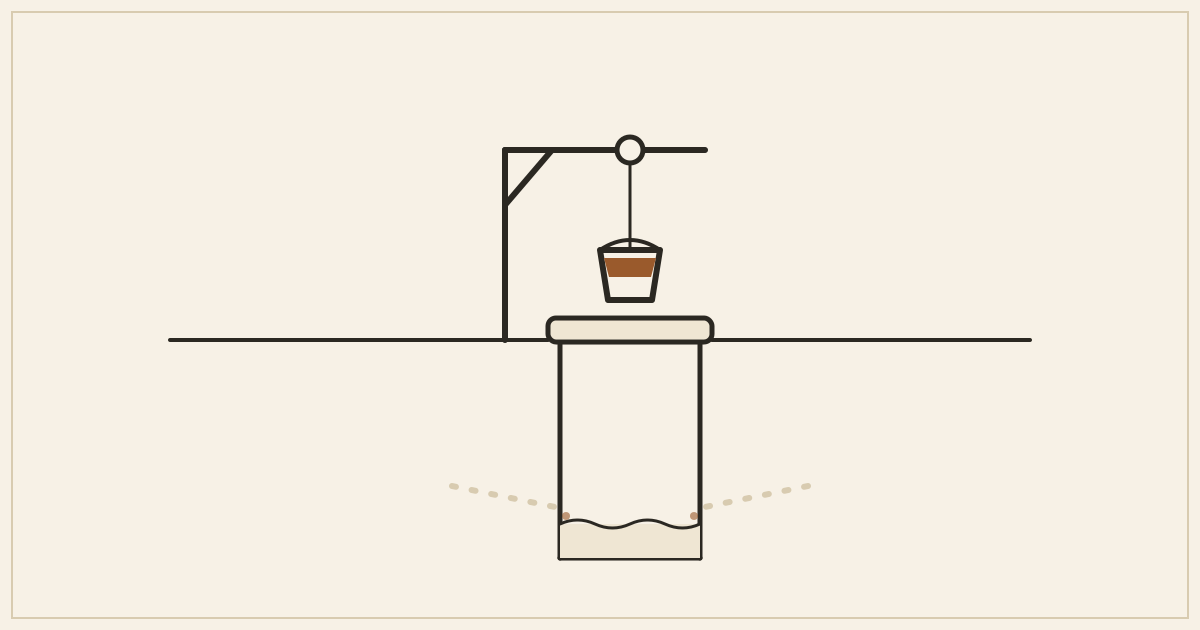
Stack Overflow used to be where a stuck programmer went to ask a stranger for help. By the end of 2024 the number of new questions posted there had fallen about 60% in a single year, and roughly 75% from its 2017 peak. The site is still up. The people just stopped asking, because a chatbot now answers instantly and for free.
Here is the twist that should keep you up at night. That chatbot learned to answer by training on fifteen years of those very questions and answers. And Stack Overflow, its traffic draining away, has signed deals to license its archive to the same AI companies that drained it. The bucket is selling the well its own water.
So who writes the next fifteen years?
The optimists have a real answer, and it deserves a fair hearing. A great deal of human knowledge was never written for money in the first place. Wikipedia, open-source code, hobbyist forums, the person who documents a rare bug at two in the morning for the pure itch of it. Strip out the ad revenue and that layer keeps going, because it never ran on ad revenue. Fair enough. But notice which layer that argument quietly protects, and which it leaves exposed.
The stuff that survives on passion alone is the casual stuff. The investigative report that takes six months, the long technical manual, the expert tutorial that assumes a decade of hard-won practice: that work needs someone to eat while it is being made. It is precisely the high-value tail, and it is precisely the part with no hobbyist backstop. Passion writes a forum post. It does not, reliably, fund a year of reporting.
Now, does the reward actually vanish, or just move?
My best guess is that it moves. When answers become free and infinite, the scarce thing is no longer the answer; it is trust. Which source is real, which author has earned the right to be believed. Reward migrates from traffic volume to verification, and in that world a known expert or a credible institution can charge for exactly what the machine can’t fake. Cheap content collapses into the model. Expensive, checkable content might become more valuable, not less, precisely because the model needs it to stay differentiated. That is not the death of the knowledge economy. It is a brutal sorting of it.
If that were the whole story I would be relaxed. It isn’t.
Three things spoil the tidy version. The first is an old problem with a new coat: the tragedy of the commons. Training data is non-excludable. If one AI company pays creators to keep writing, its rivals train on that same writing for nothing. So the individually rational move for every single player is to let someone else fund the commons. Everyone waits, and the well is nobody’s job. That is not a bug you patch with goodwill; it is a coordination failure that usually only yields to something collective, a consortium, a levy, a rule.
The second is timing, and it is the one I find genuinely unsettling. A model retrains in months. A community of expertise erodes over years. By the time the drop in fresh human knowledge shows up as a measurable dip in model quality, the people and forums that produced it will already be gone, and expertise does not reconstitute on demand. You can’t spin a craft community back up with a budget line. It dies slowly, then all at once, and then it simply isn’t there.
The third is the quiet one. The person who knows some obscure industrial process, some regional technique, had a small audience to begin with. Absorb that tiny audience into an AI summary and the reason to write it down disappears, and a lot of it was never in any training set anyway. There is a well-known 2024 result in Nature on what happens when models train too much on their own output: they degrade, and the first thing to vanish is the tail, the rare cases, the long-shot knowledge. The machine forgets the edges first. The edges are where the hard-won stuff lives.
There is a thin thread of self-interest to hang hope on. The AI firms need fresh human signal or their models slowly rot, which gives them a reason, the licensing deals, the creator funds, to keep the well wet. And every query you type is itself a kind of data, a trace of what people want and how they correct the machine. But that teaches the model our preferences, not new facts about the world. It learns what we like. It does not learn what only the person at two in the morning knew.
I don’t know which way this breaks. Nobody does. It might restructure into a healthier thing, knowledge sold on trust instead of scraped for clicks. It might hollow out so gently that we only notice when the answers start going stale.
But the shape of the risk is clear enough to name. The cost of keeping the well full is small and comes now. The cost of letting it dry is enormous and comes later, to someone else. When has that particular arithmetic ever ended well?
