The Open Cage
In 1975 the second-richest country on Earth, per head, was a twenty-one-square-kilometer rock in the Pacific.
Nauru. The island was mostly phosphate — fossilized seabird droppings, great fertilizer — and for two decades its citizens lived the exact dream every AI futurist is now selling me: no taxes, free healthcare, free schools, no need to work. Foreign workers ran the mines. The money simply arrived.
Then the phosphate ran out. The national trust fund, worth $1.3 billion in 1990, was burned down to a fraction of that through spending and comically bad investments. What’s left today: the world’s highest rate of type 2 diabetes at roughly 40% of the population, obesity near 70%, life expectancy of 62.
That is one complete, honest data point on the post-work society. I keep it taped to the inside of my skull while reading this week’s tenth essay about how AI will free us all from work.
So is the dream simply poisoned?
Not so fast. The standard comfort goes like this: we’ve been here before. In 1900 about 40% of American workers were on farms; by 2000, under 2%. The tractors came, the jobs went, and the world didn’t end — people moved to factories, then to offices. Chapter one of every economics textbook.
The comfort is true and useless at the same time. That farm shift took a century — three generations. Nobody had to stop being a farmer at 50; his son just didn’t become one. What the textbook skips is what happens when the same shift is squeezed into a decade. We have precedents for that too, and they look like coal country: from 863,000 miners down to a few tens of thousands, and towns that never recovered, because you can’t sell a house in a dying region and you can’t move a life.
Speed, not direction, is what kills.
And the textbook skips a second thing. During Britain’s industrial takeoff, output per worker rose 46% between 1790 and 1840 while real wages rose 12%. Historians call it the Engels Pause: fifty years in which the machines delivered plenty and the workers got almost none of it. The gap did close — after two generations, under political pressure that included actual riots. If AI brings its own Engels Pause, the question is not whether the wealth shows up. It’s who is holding it during the fifty years.
Now the part the doomers get wrong.
The fear that people, freed from necessity, will melt into the couch is surprisingly hard to back with data. When Finland handed 2,000 unemployed people a no-strings income in 2017–18, they did not stop looking for work — employment barely moved (six days more than the control group, in fact), while wellbeing clearly improved. Lottery winners, the cleanest natural experiment we have: in one study of 185 of them, 63% kept working full time at the same company. Around 85% kept working in some form. Ask them why and they say boredom, purpose, identity — not money.
My favorite evidence is the least respectable, which is probably why I like it. Online game economies are post-scarcity by design: nobody in EVE Online needs anything. And what do players do there, voluntarily, in their free time? They grind. They run spreadsheets, manage supply chains, herd hundreds of people in guilds, and invent artificial scarcity so their effort means something. Hand humans paradise and we immediately open a job site on it.
I suspect the whole “humans naturally at rest” picture was always a myth. The anthropologist Marshall Sahlins famously argued that hunter-gatherers worked twenty-hour weeks — the “original affluent society.” Later counts across dozens of foraging societies put it closer to 40–45 hours. Maybe we never were the leisure species. Maybe we’re just the working species, and the only question is whether the work is forced or chosen.
So if laziness isn’t the danger, what is?
Look at who got the workless life early: aristocrats. The record is brutally split. Where leisure came with structure — political careers to fight over, estates to run, patronage duties, the salon rivalries that gave us half of English science — the leisure class produced. Where it came without structure, it rotted. The American planter class, freed from work by the labor of enslaved people, built almost no industry, let its universities decay, and collapsed within years of losing its labor base. The Gulf states ran the modern version: the pressure to earn a living gone in one generation, and the result was not a flowering of Arab science but cushy government non-jobs, an imported servant class, and young men who are unemployed while the country imports workers.
The pattern, as I read it: people can handle the absence of necessary work. What they can’t handle is the absence of a container — a structure where effort earns standing. Aristocrats had parliament and the hunt. EVE players have guild rankings. The Nauruans were given neither, just a check.
Here’s where I’ll plant a flag, knowing full well nobody sees the future, me included: the AI transition will hurt in a way the futurists aren’t pricing in, and it won’t be the pain of idleness. It will be the pain of the miner at 55 — not an income problem but an identity demolition, and a basic income doesn’t touch that. I’ve watched a relative go through forced early retirement; the money was fine, the man was not. And it will be the political pain of the Engels Pause: a decade or three in which the abundance is real, visible, and other people’s. The Luddites, remember, never objected to machines. They objected to the terms — who owned them, who was asked, who ate the loss. They lost, and wages took forty years to catch up.
David Graeber claimed a large share of existing jobs are already pointless and their holders know it. If he was even half right, we’re closer to this experiment than we think — much of the “necessity” of work is already theater, and AI’s real act will be switching on the house lights.
The recipe everyone asks for probably doesn’t exist. But the ingredients in every survivor’s story are boringly consistent: slow the squeeze where you can, spread the ownership so the Pause stays short, and build containers — real ones, with status attached — for effort that no longer earns a wage. Norway did roughly this with its oil, folding the windfall into a fund while everyone kept working, and remains stubbornly normal.
Whether a society can do that on purpose, at speed, under political fire — I honestly don’t know.
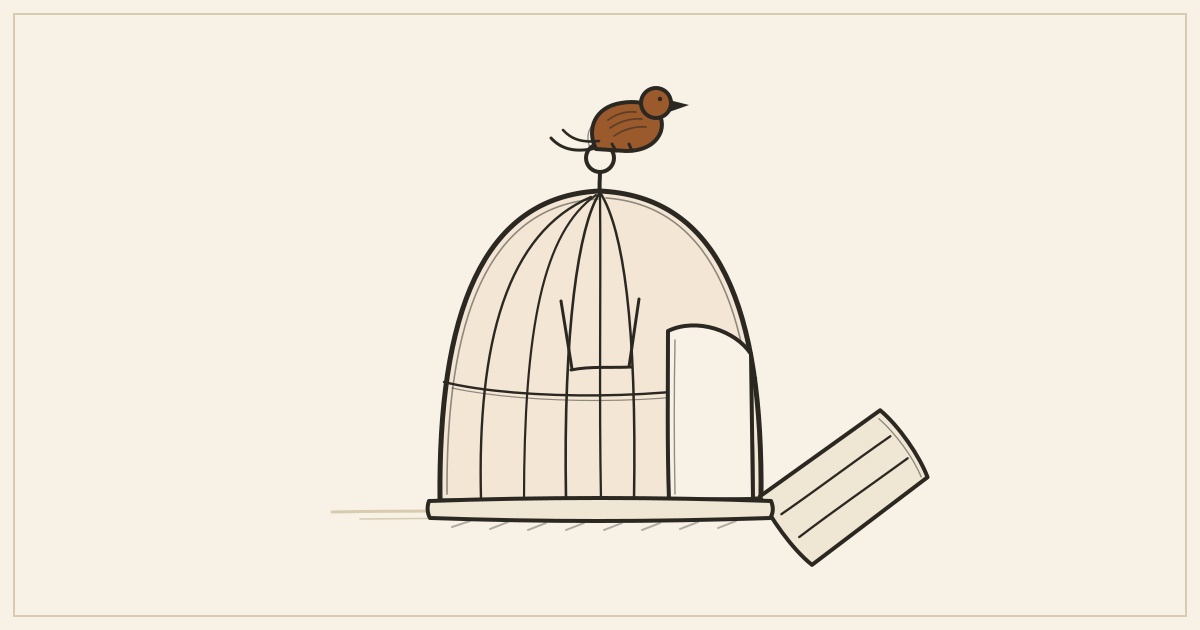
The cage door is opening either way. The interesting question was never whether the bird flies out.
It’s whether it knows what wings are for.
