A Prayer to a Man Who Never Lived
Christopher Nolan’s The Odyssey opens today, and the internet has been at war over it for months. Elon Musk announced that Nolan “has lost his integrity” for casting Lupita Nyong’o as Helen of Troy. Historians tore into the red-plumed Corinthian helmet — wrong century, apparently. Others mocked the flat American accents. Nolan shrugged: nobody arguing has seen the film yet.
Step back and look at what is actually going on here: grown men, furious about the correct portrayal of a man who never lived.
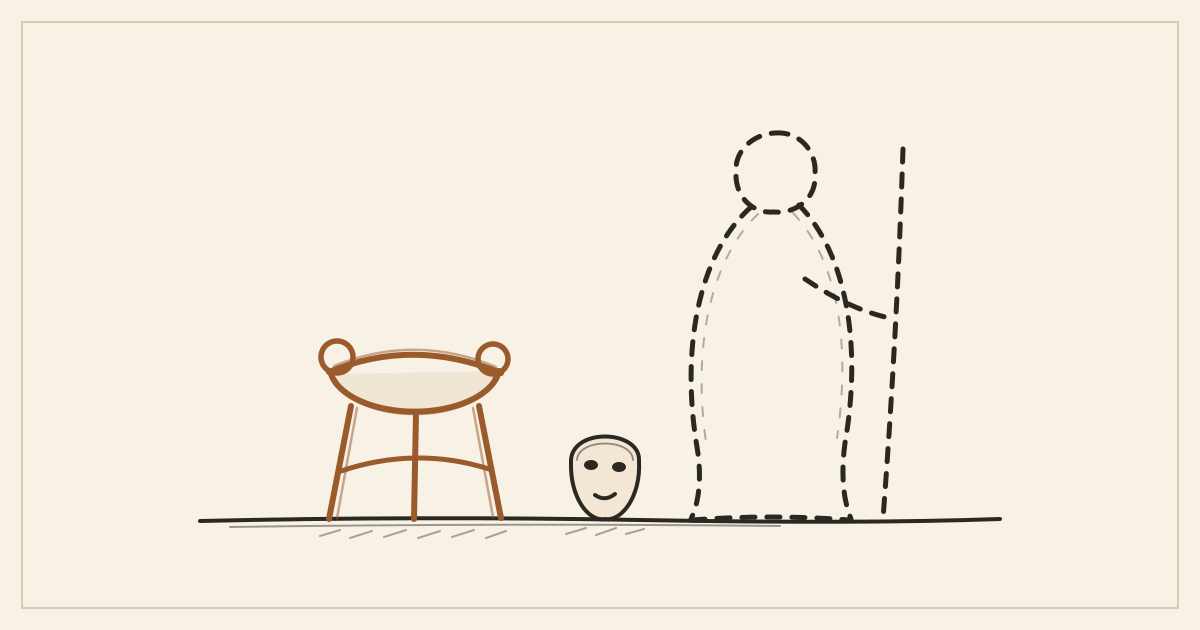
They are late to this argument by about twenty-two centuries. Sometime in the second century BC, someone on Ithaca left a clay mask in a cave at Polis Bay. Scratched into it, two Greek words: a vow to Odysseus.
Not to Zeus, who at least had the decency to be a god. To a sailor from a poem.
And the offerings didn’t stop there. Last June the University of Ioannina announced that its long-running dig at the so-called School of Homer on Ithaca is, in fact, the Odysseion — a shrine where the hero was formally worshipped. Roof tiles stamped “of Odysseus”. A small bronze bust of him from the Roman period. Pilgrims came from across the Mediterranean, for centuries, to honor a made-up man.
Now the detail that made me put my coffee down. When Sylvia Benton dug out that Polis Bay cave in the 1930s, she found twelve bronze tripods of a kind otherwise given only at Olympia and Delphi — and the offerings there go back to roughly 900 BC. Homer’s epics were composed around 750 BC.
Guess which is older, the shrine or the poem.
The worship came first. Homer didn’t create a hero whom Ithacans later adopted; Ithacans were already leaving gifts to their local hero, and the poem wrote down a practice that existed before the verses did. The text grew out of the community, not the other way around. Whatever “Odysseus” is, he was never just a literary invention that escaped the page. The page came to him.
And once a shrine exists, something quietly self-feeding begins. The shrine becomes proof of the story. Proof attracts gifts, gifts pile up the physical record, and the record makes the story more believable still — until, twenty-nine centuries later, archaeologists dig up perfectly real objects left for a perfectly unreal man. Nobody planned this. No one lied. The story built its own proof, one offering at a time.
So did the Ithacans believe Odysseus was real?
I think that’s the wrong question — and it took me a while to see why. Ancient Greeks didn’t sort the world into “really happened” and “made up” the way we do. Their working question was closer to: does this figure demand offerings? And that one was answered by custom and duty, not by evidence. Our fact-or-fiction switch is the odd modern habit here, and forcing it onto that cave says more about us than about them.
There was also a filter at work, and it looks less like an author than like natural selection. From 566 BC, professional reciters competed at a great festival in Athens, performing Homer in relay — each picking up exactly where the last one stopped, judged against each other. Run that contest every four years for centuries and the most gripping version wins, gets repeated, gets polished. Nobody decided the Odyssey would survive. The contest bred it for survival.
None of this is a Greek quirk, by the way. Rome worshipped its founder Romulus as the god Quirinus. China turned Guan Yu, a general executed in 220 AD, into a god with temples on several continents. Britain built a national identity on Arthur. The pipeline — story, cult, identity — runs wherever people need a shared “us” badly enough to pay for the stonework.
Which brings us to the uncomfortable word: if a community builds its identity on something that isn’t true, isn’t that just a very successful lie?
I say no, and the cleanest line I’ve found is time. A lie is built for short-term gain: it serves the teller at the listener’s expense, and its one requirement is not being checked too soon. A myth is the opposite bet. It must survive being checked every generation, in public, forever — and it does, because its job was never to be accurate. One is a parasite, the other a partnership; the split is not true-versus-false. The Ithacans, I suspect, knew their hero was a story and honored him anyway. A lie everyone sees through is dead. A story everyone sees through can still hold a harbor town together for a thousand years. And notice who owns each: the durable story belongs to everyone and changes freely, while the lie needs an owner to enforce it — and dies with him.
One more thing the shrine taught me. When Greeks argued about whether Odysseus was a hero or a fraud — and they argued constantly, Plato included — they were really arguing about what cleverness is worth, what a man owes his home, what you may do to get back to it. The character was a safe place to work out their own rules. No lie has ever done that job. And that is what this week’s shouting match actually is: swap the philosophers for X accounts, and the argument over who may play Helen is the same old negotiation — proof the story is still alive, not evidence that someone broke it.
I don’t know what our Odysseions are. I have my suspects — some have tickers, some have flags, at least one has a fruit logo — but the honest answer is that from the inside, you can rarely tell which stories are holding the roof up.
Twenty-nine centuries from now, what will the archaeologists dig up of ours — and will they be able to tell which of our fictions we knew were fictions?
